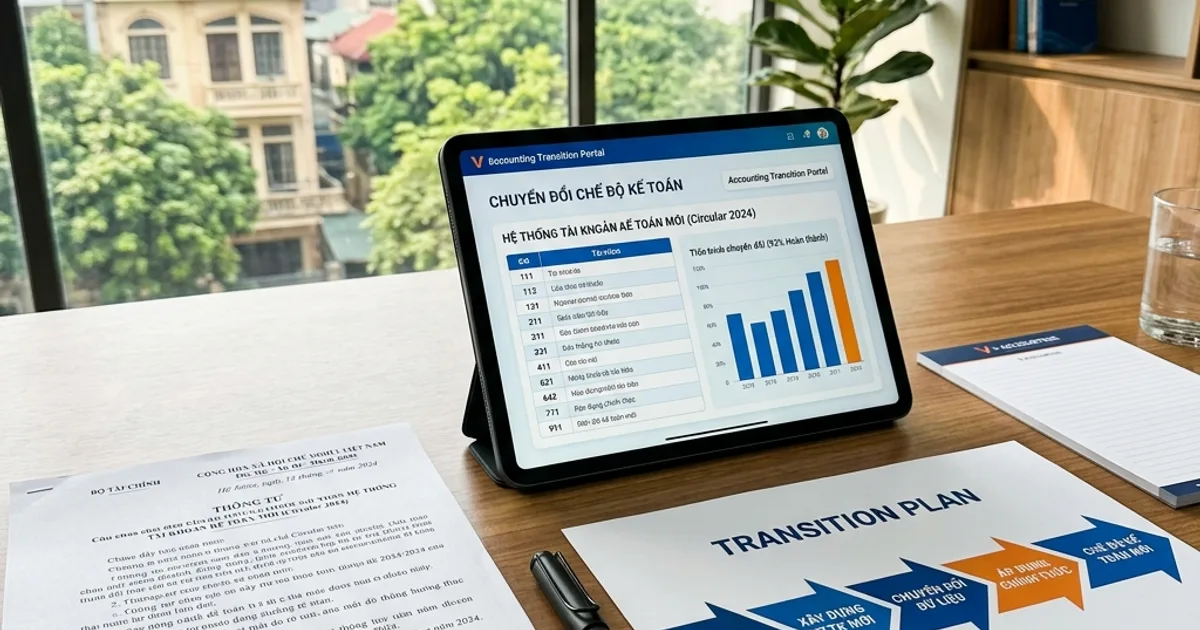






Management accounts in Vietnam are internal reports prepared for management and economic decisions, separate from the statutory VAS financial statements required under Circular 99/2025/TT-BTC, effective 1 January 2026. For ordinary FDI companies, statutory annual statements stay in VAS and VND, get audited, and are filed within 90 days of year-end, while voluntary IFRS adoption under Circular 118/2026/TT-BTC is limited to International Financial Centre members from 1 January 2027.
Vietnam accounting and reporting compliance sets the statutory baseline that every management pack must reconcile to.
Management accounts vs statutory VAS accounts in Vietnam
Vietnamese law treats management accounts as lawful accounting documents, not as a shadow set of books. The Law on Accounting 88/2015/QH13 separates financial accounting (statements for outside users) from management accounting (internal management and economic decisions), under Article 3.
The same Law requires detailed accounting figures to match summary figures for the same period, under Article 9.
Which standard applies where? Circular 118/2026/TT-BTC, effective 1 January 2027, lets only members of the International Financial Centre in Vietnam adopt IFRS voluntarily. For an ordinary FDI subsidiary, statutory financial statements follow VAS, while internal reporting follows the Law on Accounting’s management accounting framework.
| Feature | Statutory VAS accounts | Management accounts |
|---|---|---|
| Purpose | External users (tax, audit, filing) | Internal management and economic decisions |
| Standard | VAS and Circular 99/2025 (optional for SMEs) | Internal management basis (non-statutory) |
| Currency and filing | Vietnamese; VND for filed, published, or audited statements | Internal reporting (VND/bilingual rules govern statutory statements) |
| Statutory deadline | Audited annual statements filed within 90 days | Not a statutory filing |
For statutory retention, accounting books and annual financial statements are kept for at least 10 years, while accounting documents used for management and administration are kept for at least 5 years.
Basis: Law 67/2011/QH12 (audit); Circular 99/2025, Article 25 (90-day filing); Law on Accounting, Article 41 (retention).
FDI periodic reporting obligations set the statutory filing calendar.
Two reporting workflows under Circular 99/2025: VAS-first vs HQ-first conversion
Circular 99/2025 gives FDI companies statutory authority to shape the ledger around management needs. Issued on 27 October 2025, the Circular replaces Circular 200/2014/TT-BTC for financial years starting on or after 1 January 2026. From one underlying set of source documents, FDI subsidiaries either maintain a VAS-first single ledger with a monthly HQ bridge, or configure periodic reporting on an HQ IFRS or GAAP basis and group chart of accounts (COA) with a year-end conversion to VAS (subject to Article 13.10 review).
Chart of accounts changes allowed under Circular 99/2025
Circular 99/2025 changes set 71 default level-1 accounts and hand more design choices to the company. You can amend the name, number, structure, and content of accounts, and add or modify ledger formats, to meet management needs under Articles 11 and 12.
Two limits apply. The changes can’t alter the line items of the statutory financial statements. And you must issue an internal accounting policy manual (Quy chế hạch toán kế toán) that explains why each change is needed and who carries legal responsibility for it.
Small and medium-sized companies may also opt into Circular 99, provided they apply it consistently for at least one full financial year.
Model 1: VAS-first single ledger with monthly HQ bridge
Single-Ledger, Dual-View means one statutory ledger in Vietnamese feeds two outputs: the VAS statements and the HQ pack. The statutory side has fixed constraints. Accounting records use Vietnamese, and any foreign language on financial statements must appear alongside Vietnamese.
A company that mainly receives and pays in a foreign currency can keep its books in that currency if it meets the criteria in Article 4 of Circular 99/2025. Even then, statements filed with State agencies, published, or audited must be presented in VND.
The statutory set is fixed too. For going-concern entities, the Circular sets the Statement of Financial Position (Form B01-DN, renamed from the balance sheet), the income statement (B02-DN), the cash flow statement (B03-DN), and the notes (B09-DN), under Article 17.
Statutory statements that are filed, published, or audited follow those Vietnamese, VND, and form rules; internal management reports follow company management needs.
Model 2: HQ IFRS or GAAP reporting with year-end conversion to VAS
Some FDI subsidiaries connected to a global ERP structure periodic reporting on an IFRS or group GAAP basis using the HQ chart of accounts, then run a year-end conversion to VAS. Under this workflow, the finance team maps HQ accounts to the 71 default level-1 VAS accounts, posts GAAP-to-VAS adjustment entries, and generates the statutory B01-DN to B09-DN statements in Vietnamese and VND for statutory audit and the 90-day filing deadline.
Because Article 13.10 of the Law on Accounting 88/2015/QH13 prohibits keeping two or more financial accounting ledger systems, an HQ-first ERP configuration requires company-specific legal and accounting review and three operational controls under Circular 99/2025 and the Law on Accounting:
- Document the HQ-to-VAS mapping in the policy manual: record the account crosswalk, custom ledger structure, and legal responsibility inside the internal accounting policy manual (Quy chế hạch toán kế toán), ensuring statutory financial statement line items remain unchanged.
- Maintain a full reconciliation trail: preserve line-by-line IFRS/GAAP-to-VAS bridge entries so detailed accounting figures match summary statutory figures for the same period and no assets or liabilities sit off-book.
- Keep periodic Vietnam tax filings aligned year-round: file provisional quarterly CIT returns (Decree 252/2026/ND-CP, Article 24) and periodic VAT and PIT declarations on statutory Vietnam tax rules rather than waiting for the year-end conversion.
| Dimension | Model 1: VAS-first single ledger | Model 2: HQ IFRS/GAAP-first with year-end VAS conversion |
|---|---|---|
| Periodic ledger & COA | Statutory VAS ledger (71 default level-1 accounts, adapted via policy manual) | HQ IFRS or group GAAP basis using the global ERP COA |
| Conversion direction | Monthly bridge from VAS profit to HQ management profit | Year-end mapping and adjustment entries from HQ basis back to VAS |
| Year-end audit & filing prep | Statutory B01-DN to B09-DN statements ready directly from the ledger | Requires formal COA crosswalk, GAAP-to-VAS entries, and VND/Vietnamese pack |
| Operational fit | Subsidiaries prioritizing local tax/audit readiness each month | Multinationals standardizing global ERP close and converting at year-end |
Bridge adjustments between VAS profit and HQ management profit
A reconciliation bridge explains, line by line, why statutory VAS profit differs from group-basis profit: running from VAS to IFRS/GAAP under Model 1, or in reverse from IFRS/GAAP back to VAS at year-end under Model 2.
Revenue timing: e-invoice date, VAS 14 and IFRS 15
VAS 14 and the Circular 99 guidance for account 511 recognise revenue from the sale of goods when five conditions are met, built around the transfer of most risks and rewards. IFRS 15 uses a five-step model and recognises revenue when, or as, the company satisfies a performance obligation. The steps run from identifying the contract and its performance obligations to setting the price, allocating it, and recognising revenue.
Invoice timing adds a second statutory reference point. Under Decree 254/2026/ND-CP, effective 1 July 2026 together with Circular 91/2026/TT-BTC, a service invoice is issued when the service is completed, or when cash is collected before or during the service (deposits excluded).
Leases, major repairs and FX rates
VAS 06 still classifies leases as finance or operating. A lessee expenses operating lease rent on a straight-line basis and records no right-of-use asset. IFRS 16 requires a right-of-use asset and a lease liability, with exemptions for leases of 12 months or less and for low-value assets.
Major repairs follow a stricter rule under Circular 99. You accrue them only when a present obligation exists; otherwise the cost goes to account 242 and is allocated over time. For foreign-currency transactions, the approximate exchange rate in the VAS ledger must stay within a ±1% band.
Accruals without invoices and CIT deductibility
For statutory CIT purposes, expenses recorded without lawful documentation do not meet the deductibility conditions under Decree 320/2025/ND-CP, Article 9, which requires all three conditions to hold together:
- Real and business-related: the expense actually arises and relates to production or business.
- Documented: lawful invoices and supporting documents exist.
- Paid without cash: each purchase or payment of VND 5 million or more carries non-cash payment records.
| Item | VAS statutory position | HQ / IFRS management position | Basis |
|---|---|---|---|
| Sale of goods and service invoices | Five conditions around risks and rewards for goods; service invoice on completion or collection | Recognised as performance obligations are satisfied | VAS 14; Decree 254/2026 |
| Leases | Operating lease rent expensed straight-line | Right-of-use asset and lease liability | VAS 06; IFRS 16 |
| Major repairs | Accrued only with a present obligation, otherwise account 242 | Group policy | Circular 99/2025 |
| FX rate | Approximate rate within ±1% | Group policy | Circular 99/2025 |
| Accruals without invoices | Non-deductible without lawful documents and non-cash payment from VND 5 million | Group policy | Decree 320/2025 |
VAS and IFRS differences extend well beyond these five items; the sibling guide compares the two frameworks standard by standard.
When management accounts become a two-book risk
Management accounts become a legal risk when they rely on a second financial accounting ledger system, leave assets or liabilities off the books, or produce inconsistent statutory financial statements for the same period. Article 13 of the Law on Accounting prohibits all three practices.
Under Articles 3 and 9 of the same Law, management reports qualify as internal accounting documents for management decisions, and detailed figures in the accounting system must match summary figures for the same period.
Chief Accountant role vs HQ management reporting
Under the Law on Accounting (Articles 53 and 54), accounting units must appoint a Chief Accountant or hire a Chief Accountant service meeting statutory conditions, unless the law provides otherwise; an acting person can fill the post for up to 12 months, under Decree 174/2016/ND-CP. Organisation fines reach VND 20–40 million for failing to arrange one and VND 40–60 million for an unqualified appointee, under Decree 41/2018.
Accounting and bookkeeping services cover both the statutory VAS ledger and the chart mapping that feeds HQ management reporting.
Next steps for your management pack
- Set your reporting workflow (VAS-first with a monthly HQ bridge, or HQ ERP mapping subject to statutory VAS ledger compliance) and issue an accounting policy manual under Articles 11 and 12 of Circular 99/2025.
- Keep detailed accounting figures reconciled to summary figures for the same period under Article 9 and retain documents used for management and administration for at least 5 years.
- Keep all assets and liabilities on the statutory ledger and appoint a Chief Accountant or eligible service where required.
ICLV’s IFRS Compliance team, led by Ken Lam, provides statutory VAS bookkeeping and HQ management reporting reviews. Schedule a Free Consultation.
Information current as of November 2026; general guidance, not company-specific advice.