







Foreign-invested companies selling to consumers in Vietnam must obtain a trading license from the provincial Department of Industry and Trade (DOIT). This requirement applies to all retail operations targeting end consumers—physical stores, showrooms, e-commerce—regardless of whether you sell imported or domestically-sourced products. The legal basis is Decree 09/2018/ND-CP, effective 15 January 2018.
The Investment Registration Certificate (IRC) and Enterprise Registration Certificate (ERC) establish the legal entity. They don’t grant selling rights. Trading without a license triggers fines of VND 40–60 million (~USD 1,600–2,400) plus goods confiscation and potential suspension per Decree 98/2020/ND-CP, as amended by Decree 17/2022/ND-CP. The IRC and ERC are the foundation—the trading license is the operational permit built on top.
For the full Vietnam market entry roadmap, see the complete guide to doing business and setting up a company in Vietnam.
When You Need a Trading License
The business model determines the answer. Wholesale-only operations selling exclusively to other businesses (B2B) can operate under IRC and ERC authority, provided the IRC clearly records distribution business lines under the appropriate Central Product Classification (CPC) codes and activities stay within registered scope. But the boundary matters—if a single transaction goes to an end consumer, the company has crossed into retail territory. Entity structure also affects trading eligibility—branches and representative offices face different restrictions than LLCs. See LLC vs. JSC vs. representative office vs. branch structures for foreign investors in Vietnam.
The moment you sell directly to end consumers (B2C), you need a trading license. This applies whether you’re running physical retail, showrooms, or online sales. It applies to imported goods and domestically-sourced products equally.
E-commerce creates a dual licensing requirement: the company needs a trading license from DOIT plus e-commerce notification or registration with the Ministry of Industry and Trade (MOIT). The specific MOIT requirement depends on the online model—marketplace platforms serving third-party sellers face different requirements than websites selling only the company’s own goods. Cross-border e-commerce adds customs registration on top.
| Activity | Trading License | E-Commerce Registration | Both Required |
|---|---|---|---|
| Physical retail only | ✓ | ✗ | No |
| Online retail (domestic) | ✓ | ✓ | Yes |
| Cross-border e-commerce | ✓ | ✓ + Customs | Yes |
Conditional goods categories—pharmaceuticals, cosmetics, food products, and cultural goods—require sector-specific approvals from the relevant ministry before DOIT will process the trading license application. Don’t assume a product category is open to foreign distribution. Verify first.
Budget for dual timelines if planning omnichannel operations. E-commerce registration adds 15–20 days beyond the trading license process. Don’t launch your website before securing both licenses—MOIT monitors for unlicensed operators, and penalties start at VND 10 million (~USD 400).
Application Process and Timeline
DOIT at provincial level processes trading license applications. The statutory timeline is 30 working days from receiving complete documentation (Decree 09/2018/ND-CP). Reality: expect 45–50 days. DOIT frequently issues supplementation requests within the first 15 days, resetting the review clock.
Required documents:
- Application form (DOIT’s prescribed format)
- Financial capacity proof (audited statements preferred; bank statements accepted for newly-established companies)
- Explanation of how you satisfy licensing conditions
- Head office lease agreement (must match registered ERC address)
- WTO/FTA commitment schedule citation if claiming CPTPP or EVFTA ENT exemptions
DOIT scrutinizes financial capacity heavily—HCMC and Hanoi request supplementary documents when submissions show thin capitalization relative to proposed trading scale. Site inspections verify premises match lease documentation. If the application involves goods subject to ENT and the company doesn’t qualify for FTA exemptions, DOIT conducts a market assessment—rejection is possible if they deem the market oversupplied in the target area.
Submit applications through the National Public Service Portal for tracking. Portal submissions require valid corporate e-ID credentials.
Retail Outlet Licensing and FTA Exemptions
The trading license grants distribution rights. It doesn’t authorize physical retail locations—each outlet requires a separate retail establishment license from DOIT.
Per-outlet requirements: trading license copy, outlet lease agreement, store layout plan, and goods categories explanation. DOIT aims to process retail outlet licenses within roughly 10 working days per location, though actual processing stretches when ENT assessments or supplementation requests arise.
The ENT gate. Unless you qualify for an exemption, DOIT conducts an Economic Needs Test evaluating market density, existing retail presence, and consumer demand in your target area. ENT rejections occur more frequently in prime urban locations—central districts in Hanoi, HCMC, and Da Nang—so many investors explore secondary cities or suburban areas to improve approval odds.
CPTPP and EVFTA exemption. Investors from CPTPP (Comprehensive and Progressive Agreement for Trans-Pacific Partnership) or EVFTA (EU-Vietnam Free Trade Agreement) member states may qualify for ENT exemption under specific conditions—typically when the outlet is located in a shopping center or commercial complex and total floor area stays under 500m². Confirm eligibility with DOIT for your specific project.
The 500m² threshold is measured strictly. DOIT counts gross floor area including storage, offices, and back-of-house space. If the combined area exceeds 500m², the company loses the exemption even when the sales floor alone stays under the threshold.
For non-FTA investors facing ENT rejection, you can appeal to the provincial People’s Committee—but expect 30–45 additional days with low success rates. Relocating to a less saturated area and reapplying is usually faster.
The ENT test is the market access gate DOIT uses to evaluate whether new retail entrants serve genuine economic needs in a given area. DOIT evaluates existing retail density, consumer demand, and infrastructure capacity at the district level in cities and provincial level in rural areas.
The assessment methodology and scoring criteria aren’t published—decisions remain discretionary, which is why location strategy matters as much as documentation quality. For the full conditional business line framework, see conditional business lines in Vietnam.
Distribution companies import goods. Every import payment flows through the Direct Investment Capital Account (DICA). If the DICA isn’t structured correctly—wrong currency designations, missing authorized signatories—the company can’t pay foreign suppliers or clear customs. Set up the DICA early, before the first purchase order.
Amendments, Renewal, and Penalties
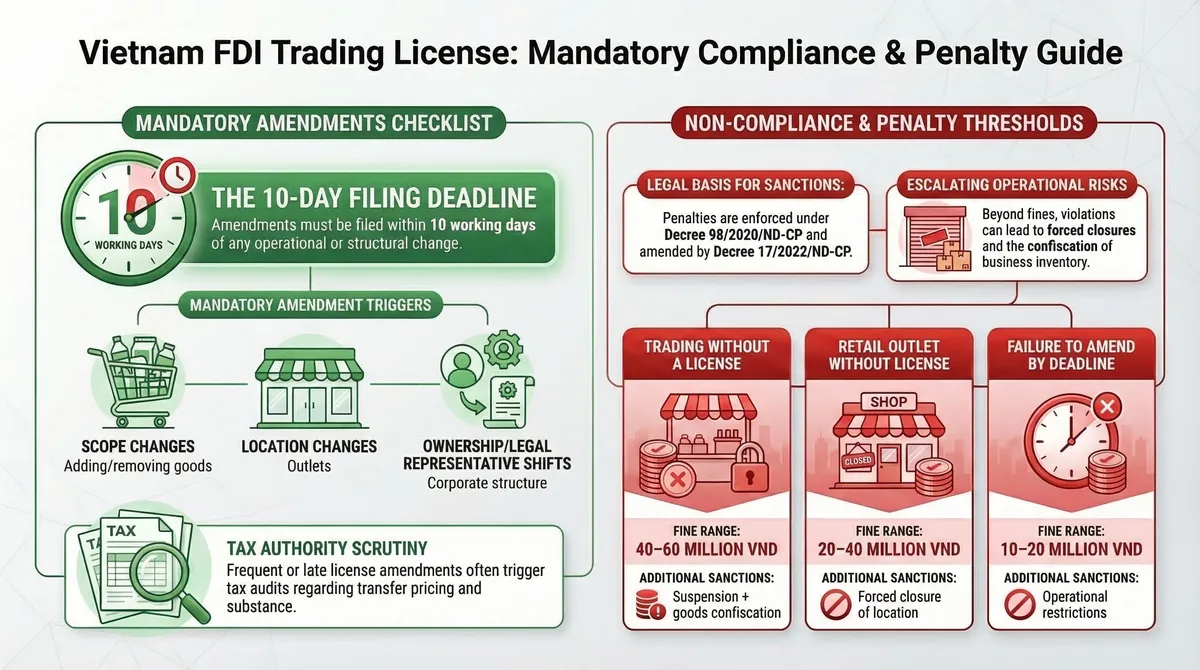
Trading license validity aligns with the investment project duration. Three scenarios trigger mandatory amendments:
Goods scope changes—adding new product categories or removing existing ones. Be aware that certain categories remain restricted even with a valid trading license: pharmaceuticals require separate import licenses and Good Distribution Practice certification from the Ministry of Health, petroleum products are prohibited for foreign retail distribution, and cultural goods (books, films, music) need Ministry of Information and Communications content approval.
Retail location changes—opening new outlets or closing existing ones. Corporate structure changes—ownership shifts or legal representative changes that affect the company’s licensed scope and liability exposure.
File amendments within the deadlines prescribed by Decree 09/2018/ND-CP. Delays attract fines and additional measures per Decree 98/2020/ND-CP, as amended by Decree 17/2022/ND-CP. In practice, frequent amendments may attract closer scrutiny from tax authorities reviewing transfer pricing and business substance.
| Violation | Fine (VND) | Fine (~USD) | Additional Sanctions |
|---|---|---|---|
| Trading without license | 40–60 million | ~1,600–2,400 | Suspension + goods confiscation |
| Retail outlet without license | 20–40 million | ~800–1,600 | Forced closure |
| Failure to amend within deadline | 10–20 million | ~400–800 | Operational restrictions |
Post-licensing compliance: File annual activity reports to DOIT by January 31 each year, covering trading activities, sales volumes, and retail outlet operations. Maintain all product-specific sub-licenses (cosmetics, food, pharmaceuticals) in valid status. If you operate e-commerce alongside physical retail, maintain active registration on the MOIT e-commerce portal—updated annually.
DOIT in Hanoi and HCMC conducts random compliance audits of foreign-invested trading companies—they verify actual activities match licensed scope, inspect retail outlets for proper documentation, and cross-check annual reports against customs import data.
Discrepancies trigger penalties and potential license revocation proceedings. Tax authorities separately cross-reference revenue sources against licensing documentation—generating B2C retail revenue without a trading license gets flagged as unlicensed commercial activity, triggering both DOIT penalties and potential tax reassessments.
Plan Your Timeline
Trading license compliance is non-negotiable for FDI retail and distribution. The silent traps are amendment triggers—adding products, opening stores, changing ownership—that most companies miss until they’re facing penalties.
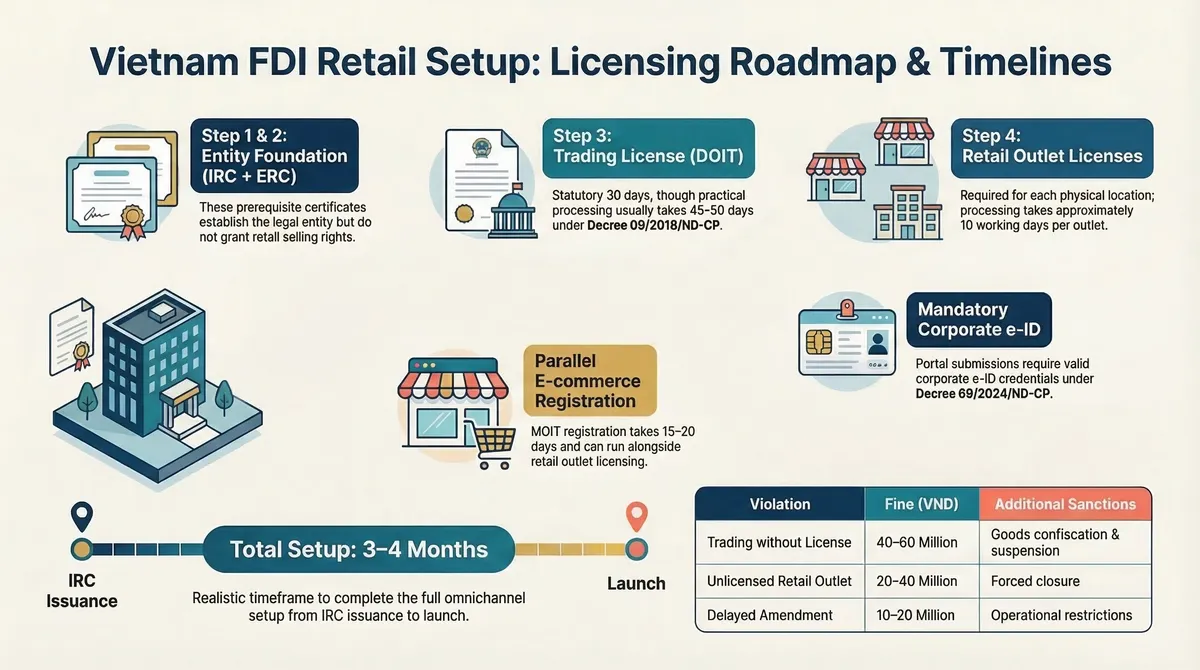
Realistic timeline planning: trading license takes 45–50 days (30 statutory plus supplementation rounds), retail outlet licenses take 10 days per location (longer with ENT assessment), and e-commerce registration adds 15–20 days. Plan for 3–4 months total from IRC issuance to full retail operations if running omnichannel.
The sequence matters. IRC and ERC come first—you can’t apply for a trading license without them. Trading license comes second—you can’t open retail outlets without it. Retail outlet licenses come third—each location needs its own. E-commerce registration runs in parallel with outlet licensing if you’re planning both channels. Miss any step in the sequence, and you’re operating unlicensed until you catch up.
Ownership restructuring triggers mandatory trading license amendments—factor amendment processing into any corporate restructuring timeline. And if retail licensing complexity exceeds your current commitment level, market entry without full incorporation offers alternatives—see representative office vs. EOR for market entry without incorporation in Vietnam.
Need trading license support? Indochina Link Vietnam handles dossier preparation, DOIT liaison, supplementation management, and post-licensing compliance tracking. From company registration through trading license acquisition, we manage the full formation lifecycle for foreign-invested retail and distribution companies across all Vietnamese provinces.
LEGAL DISCLAIMER
This article provides general information about Vietnamese trading license requirements. It does not constitute legal advice. Regulations are subject to change—always verify current requirements with DOIT and qualified legal counsel before committing to retail operations. Information current as of February 2026.