







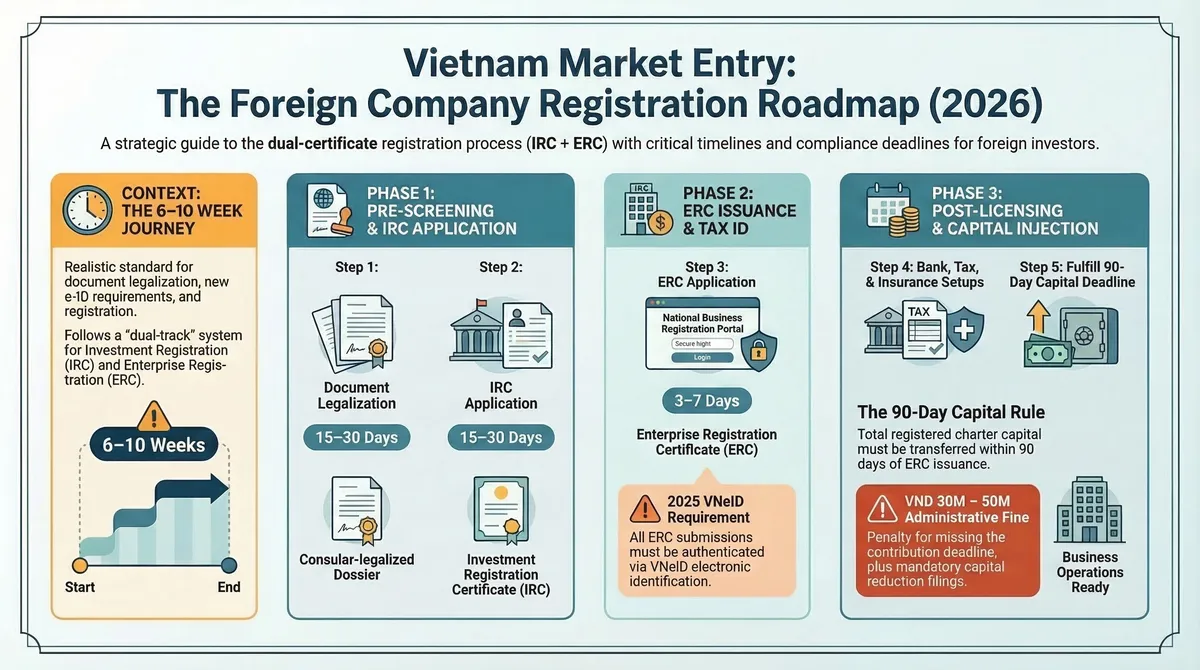
Foreign investors need two certificates to operate in Vietnam: the Investment Registration Certificate (IRC) from the Department of Finance (formerly Department of Finance (formerly DPI)), followed by the Enterprise Registration Certificate (ERC) from the Business Registration Office. The IRC processes within 15 working days and the ERC within 3 working days (Decree 31/2021/ND-CP as amended by Decree 239/2025/ND-CP, effective September 3, 2025; Law on Investment 2025, Article 37).
The combined 15+3 working day statutory timeline rarely reflects reality. The actual registration process runs 6–10 weeks once document legalization, Department of Finance (formerly DPI) clarification requests, and the 2025 e-ID requirement under Decree 69/2024/ND-CP are factored in. Miss the 90-day charter capital deadline after ERC issuance, and the company may face a VND 30–50 million (~USD 1,200–2,000) administrative fine and be required to register a capital reduction to the actually contributed amount under Decree 122/2021/ND-CP, Article 46.
This guide covers the prerequisites, dual-track registration process, and critical post-licensing steps for foreign company registration in Vietnam.
This guide assumes you’ve already chosen your entity structure — LLC, JSC, or joint venture. If you’re still evaluating which structure fits your investment, start with our comparison of LLC vs JSC vs representative office vs branch for foreign investors in Vietnam.
Registration Prerequisites
Foreign company registration in Vietnam requires satisfying four prerequisites before IRC submission. Missing any one triggers immediate application rejection by Department of Finance (formerly DPI).
Investor Eligibility & Document Legalization
All foreign documents—passports, certificates of incorporation, articles of association—must be consular legalized, authenticated at Vietnam’s MOFA, then translated and notarized in Vietnam. The legalization chain: notarize in home country → consular legalize at Vietnamese embassy → authenticate at MOFA → translate and notarize translation in Vietnam. Document legalization adds 15–30 days before IRC submission. Start this process immediately once you’ve decided on Vietnam—don’t wait until you’ve found office space.
Capital Requirements & Department of Finance (formerly DPI) Feasibility Test
Vietnam imposes no general minimum charter capital for most sectors (Law on Enterprises 2020). But Department of Finance (formerly DPI) applies a “feasibility test”—rejecting capital insufficient to cover the costs in your investment proposal. Department of Finance (formerly DPI) calculates feasibility from your proposal’s cost breakdown: land lease deposits, equipment, initial working capital, first-year operating expenses. A manufacturing facility proposing USD 500,000 in machinery cannot register with USD 50,000 charter capital.
Sector-specific minimums apply separately: real estate development VND 20 billion (~USD 800,000), securities trading VND 50 billion (~USD 2 million), banking VND 3,000 billion (~USD 120 million). In-kind contributions (machinery, IP, technology transfers) count toward charter capital if independently valued by licensed appraisal companies (Decree 31/2021/ND-CP, Article 28)—valuation and Department of Finance (formerly DPI) approval add 30–45 days.
Registered Address
Foreign-invested companies need a physical commercial address before ERC issuance (Law on Enterprises 2020, Article 37). Residential condominiums and apartments are not accepted by business registration authorities under the Housing Law 2023. Acceptable options: commercial office buildings (minimum 1-year lease with landlord’s ownership certificate attached), industrial zone land plots (Land Lease Agreement with IZ Management Board specifying plot and lease term), or co-working spaces with exclusive-use confirmation.
HCMC and Hanoi Business Registration Offices reject generic “hot desk” arrangements. Virtual offices are permissible for service companies but face closer scrutiny from tax authorities to verify actual presence.
The catch: landlords require seeing your ERC before signing a lease—but you need a lease to get the ERC. The practical solution is an MOU-to-Lease structure: a short-term MOU (valid for licensing) that converts to a full lease upon ERC issuance.
For the complete guide to doing business and setting up operations in Vietnam, see our pillar guide.
Legal Representative Requirements
Every company must appoint at least one legal representative who carries personal liability beyond their employment scope and resides in Vietnam. This isn’t just a formality—the legal rep is the mandatory authorized person for banking, tax, and licensing procedures.
Residency and work permit: Department of Finance (formerly DPI) expects the legal representative to hold a valid basis for long-term residence (TRC or work permit)—tourist visas are not accepted. Owning the company doesn’t guarantee a work permit exemption—under Decree 219/2025/ND-CP, exemptions are limited to specific categories including owners or capital contributors meeting prescribed thresholds. Verify current exemption criteria with your legal advisor.
The e-ID dependency: After ERC issuance, registering the company’s corporate e-ID requires the legal representative to hold a personal VNeID (Decree 69/2024/ND-CP). This creates a circular dependency for foreign investors without residency. The practical solution: appoint a qualified local resident legal representative for the initial setup phase, then file an amendment to transfer the role once the foreign investor’s residence permit is processed.
Multiple representatives: Companies can appoint more than one legal rep—one foreign Director for strategic decisions, one local Manager for administrative compliance. Define each rep’s authority scope clearly in the Company Charter.
The Dual-Track Registration Process
Step 1: Pre-Investment Screening
Vietnam’s IRC approval process includes additional screening layers depending on sector and project scale. Two distinct mechanisms apply:
Type A — Conditional Market Access (Sector-Based): If your business line falls under the conditional business lines and market access requirements in Vietnam—logistics, education, e-commerce, trading of specific goods—Department of Finance (formerly DPI) can’t approve the project alone. Department of Finance (formerly DPI) must initiate a “Ministry Consultation,” sending your dossier to the relevant federal ministry (MOIT, MOET, etc.) for their opinion. This adds 30–60 days to the standard timeline. It’s not a separate pre-license; it’s a mandatory pause built into the IRC appraisal process under Decree 31/2021/ND-CP.
Type B — Investment Policy Approval (Scale/Impact-Based): Projects with significant social or land-use impact require formal Investment Policy Approval (Chấp thuận chủ trương đầu tư) from the Provincial People’s Committee or Prime Minister before IRC submission (Law on Investment 2025, Articles 24–25). Triggers include residential housing construction, golf courses, household relocation projects, and operations in defense/border areas. These procedures add 3–6 months before the standard workflow even begins.
Most SME and standard manufacturing projects only face Type A. However, if your project location sits within a high-tech park or requires repurposing agricultural land, it may inadvertently trigger Type B. Screen your project location against the provincial land-use master plan early.
Step 2: IRC Application
Department of Finance (formerly DPI) or the Industrial Zone Management Board issues the IRC within 15 working days (Article 37, Law on Investment 2025; Decree 239/2025/ND-CP). In practice, expect 3–5 weeks including clarification rounds.
Required documents:
- Project Proposal: Feasibility study covering business scope, capital structure, and implementation timeline. Projects exceeding VND 375 billion (~USD 15 million) require third-party feasibility validation—adding 15–20 days
- Financial Proof: Corporate investors submit audited financials (last 2 years) or bank confirmation of funds. Individual investors provide passport and personal bank balance showing sufficient funds
- Location Documents: Office lease or MOU specifying exact address. Industrial zone projects require a Land Lease Agreement
- Power of Attorney: Notarized POA from the parent company’s legal representative, consular-legalized
- Establishment Documents: Certificate of Incorporation and Articles of Association, consular-legalized
Pre-submission draft review: Department of Finance (formerly DPI) scrutinizes consistency between your IRC scope and the parent company’s existing business lines. Holding companies with no operational history in the proposed sector face 2–4 week delays while Department of Finance (formerly DPI) requests supplementary evidence of the investor’s capability. Submitting a draft dossier to the assigned specialist officer before formal filing catches subjective objections about business scope wording—saving weeks of back-and-forth after official submission. This informal pre-check is standard practice among experienced service providers and dramatically reduces rejection risk.
Step 3: ERC Application
The ERC gives the company legal standing, assigns the Tax Identification Number, and authorizes bank accounts, hiring, and contracts (Law on Enterprises 2020, Articles 27–30). Timeline: 3–7 working days practically (3 WD statutory under Decree 01/2021/ND-CP). Required documents: company charter (must align with IRC capital/scope), member list, legal representative details, and IRC copy.
The post-ERC e-ID bottleneck: The company must register its corporate e-ID to activate digital tax filing and e-invoice issuance. Corporate e-ID registration requires the legal representative to authenticate with a personal VNeID—which only Vietnamese citizens and foreigners with valid TRCs can obtain. This is the primary reason we recommend appointing a local resident legal representative during the initial setup phase.
A practical solution is to appoint a local nominee LR who holds a valid VNeID to complete the corporate e-ID registration and initial post-licensing setup. Once the foreign investor obtains a work permit and TRC, file an ERC amendment to transfer the legal representative role.
Always request a scan of the Draft ERC before the final signature. A single character mismatch between your ERC and lease address can freeze bank account opening for weeks. Verify every detail against the lease before the official red seal is applied.
Step 4: Post-Licensing Essentials
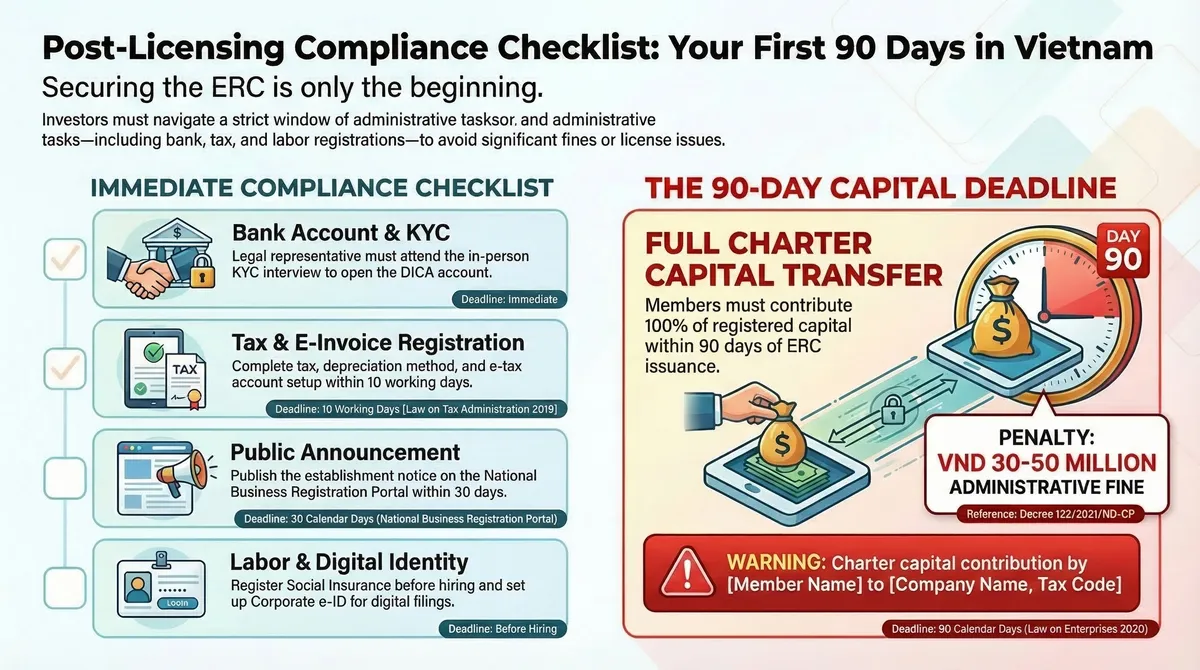
The ERC establishes legal status, but FDI companies must complete post-licensing registrations before operating and issuing invoices:
- DICA bank account — the legal representative must attend the KYC interview in person. Open a DICA at an SBV-licensed bank for charter capital inflows, plus VND/foreign currency payment accounts for daily operations
- Tax registration — register tax method, depreciation method, fiscal year, and e-tax account with the local tax office within 10 working days (Law on Tax Administration 2019, Article 33). Missing this deadline triggers a VND 2–5 million penalty
- Social insurance registration before hiring your first employee — see our employment law guide
- Corporate e-ID for digital tax filing from 2025
- E-invoice registration — mandatory for VAT invoices
- Sector sub-licenses for conditional sectors: F&B needs a Food Safety License, construction needs a Competency Certificate, and retail requires a trading license before generating revenue
- Trademark registration — file with IPVN as early as possible. Vietnam’s first-to-file system means delays risk losing your brand name to local squatters. Filing can proceed in parallel with company registration
- Public announcement — publish the establishment notice on the National Business Registration Portal within 30 days
The 90-Day Capital Contribution Deadline
The 90-day charter capital contribution deadline is the most common compliance trap for new foreign investors. Members must contribute the full registered charter capital within 90 days from ERC issuance (Law on Enterprises 2020, Article 47). If a member hasn’t fully contributed, the company must register to reduce charter capital within 30 days of the deadline.
Consequences of missing it: VND 30–50 million (~USD 1,200–2,000) administrative penalty (Decree 122/2021/ND-CP), mandatory capital reduction to the actually contributed amount (triggering a 30-day creditor notification period), and potential license revocation for conditional sectors. Banks freeze credit facilities. Tax authorities flag the entity for audit priority.
The wiring syntax requirement: When transferring capital from abroad, the remittance message must state exactly: “Charter capital contribution by [Member Name] to [Company Name, Tax Code].” If the bank note says “Loan,” “Project Fund,” or just “Transfer,” the bank can’t legally record it as equity. The bank will reject the contribution, requiring a refund and re-transfer with correct syntax—wasting weeks and incurring double forex conversion losses.
Open your DICA immediately upon receiving the ERC and confirm the exact wiring instructions with your bank officer before initiating the transfer. Obtain the bank’s Capital Contribution Confirmation within 5 working days of funds receipt—this document is mandatory for your year-end financial audit and CIT finalization.
Realistic Timeline
| Phase | Duration | Key Output |
|---|---|---|
| Document Legalization | 15–30 days | Consular-legalized investor documents |
| Conditional Sector Approval (if applicable) | 30–60 days | Ministry consultation opinion |
| IRC Application | 15–30 days (practical) | Investment Registration Certificate |
| ERC Application | 3–7 days (practical) | Enterprise Registration Certificate + TIN |
| Post-Licensing Setup | 10–20 days | Bank, tax, SI, e-invoice, e-ID |
| Capital Contribution | Within 90 days of ERC | DICA confirmation letter |
Total: roughly 43–87 days for standard projects, and around 73–147 days if conditional sector approval is required.
Parallel processing strategy: Foreign company registration timelines shorten significantly when workstreams run concurrently rather than sequentially. Start document legalization immediately. While waiting for legalization, secure your office lease MOU, finalize the feasibility study, and line up your legal representative’s work permit application. Begin trademark filing at IPVN in parallel—it proceeds independently from company registration. Have your service provider prepare the draft IRC dossier for Department of Finance (formerly DPI) informal pre-check while legalized documents are in transit.
The critical path bottleneck for most investors is the IRC clarification rounds—Department of Finance (formerly DPI) officers requesting supplementary information about business scope or capital adequacy. Each clarification round adds 5–10 working days. A thorough initial submission that anticipates common Department of Finance (formerly DPI) objections is more valuable than rushing to file an incomplete dossier.
Indochina Link Vietnam handles the complete IRC-to-operational workflow: pre-investment screening, document legalization coordination, IRC/ERC applications, and post-licensing setup. Our company registration service manages authority interactions and statutory deadlines end‑to‑end. If you need to map your project’s registration path, contact us for a tailored feasibility assessment.
Important: This information reflects regulations current as of March 2026, including the Law on Investment 2025 (143/2025/QH15, effective March 1, 2026). Vietnamese investment and enterprise laws change frequently. For specific situations, consult qualified legal and tax professionals licensed in Vietnam.