







Adjusting corporate capital in a foreign direct investment (FDI) enterprise in Vietnam requires coordinated administrative filings across investment and corporate licensing authorities. Under the Law on Investment 2025 (Law No. 143/2025/QH15, effective March 1, 2026), the Law on Enterprises 2020 (Law No. 59/2020/QH14 as amended by Law No. 76/2025/QH15), and Decree 31/2021/ND-CP (amended by Decree 239/2025/ND-CP), an adjustment to registered charter capital generally necessitates amending the Investment Registration Certificate (IRC) before updating the Enterprise Registration Certificate (ERC).
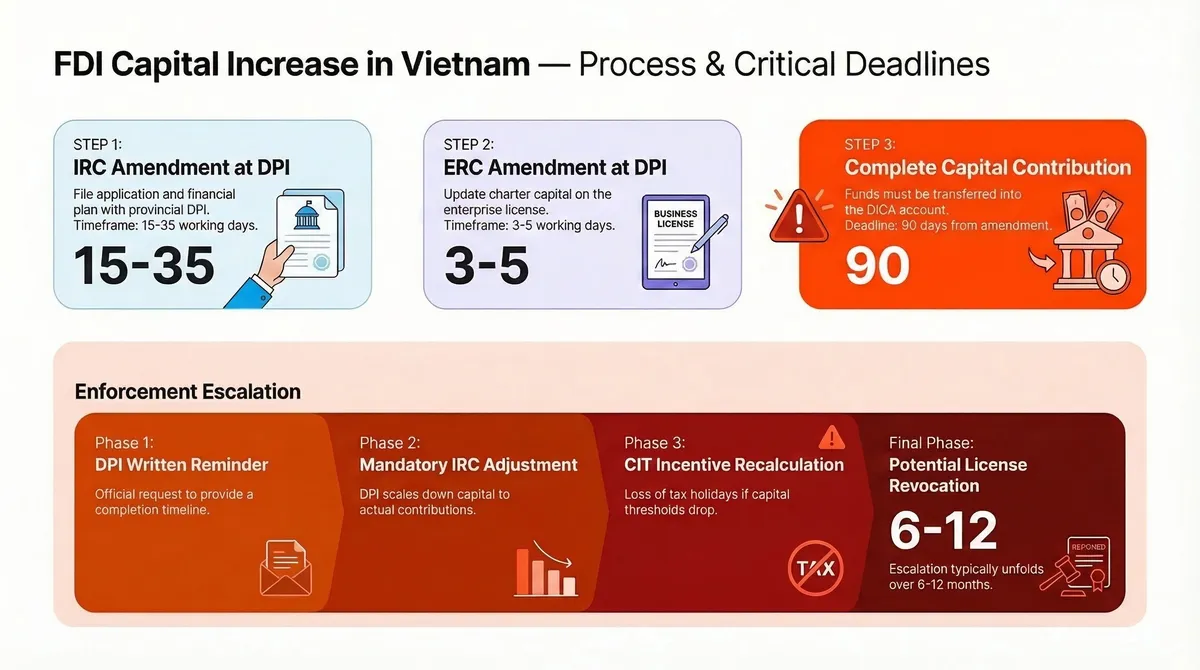
The IRC amendment is administered by the provincial Department of Finance (incorporating the former Department of Planning and Investment - DPI under Decree 150/2025/ND-CP) or the Industrial Zone Management Board within 10 working days under Decree 239/2025/ND-CP. Subsequently, the ERC amendment is processed by the Business Registration Office (Phòng Đăng ký kinh doanh) under the Department of Finance within 03 working days under Decree 01/2021/ND-CP.
Whether scaling up manufacturing facilities, funding working capital, reorganizing capital structure, or exiting underperforming assets, capital restructuring is an integral operational milestone in the Vietnam business setup lifecycle. However, corporate capital adjustments involve strict foreign exchange controls, solvency covenants, and tax exposure. Mismatched filings can void Corporate Income Tax (CIT) holiday entitlements and trigger regulatory sanctions under Decree 122/2021/ND-CP.
1. Regulatory Framework: Dual-Track Licensing Sequence
Because an FDI company charter capital directly defines the foreign equity commitment of the approved investment project, capital changes impact both the project-level permit and the entity-level legal registration.
Why IRC Amendment Precedes ERC Amendment
In Vietnamese corporate practice, licensing authorities require corporate documents to remain synchronized:
- Total Investment Capital vs Charter Capital: The IRC defines both total investment capital (encompassing equity and debt/loan financing) and charter capital (equity contributed by investors).
- Sequential Approval: The Business Registration Office will not alter registered charter capital on the ERC without verified proof that the investment licensing authority has officially endorsed the revised investment project parameters on the IRC.
- Statutory Timeframes: Under Decree 239/2025/ND-CP, standard IRC adjustments take 10 working days from receipt of a complete and valid dossier. Routine administrative adjustments can be finalized in 03 working days. Once the amended IRC is released, the ERC amendment takes 03 working days under Decree 01/2021/ND-CP.
Failing to update certificates while adjusting capital structures exposes companies to administrative fines under Decree 122/2021/ND-CP and challenges during annual tax finalizations.
2. Capital Increase: Statutory Methods and Execution
FDI enterprises expand registered charter capital to finance new production lines, meet regulatory capital thresholds in conditional sectors, improve borrowing limits, or reinvest operational surpluses.
Four Permissible Capital Injection Methods
Under the Law on Enterprises 2020 and State Bank of Vietnam (SBV) regulations, foreign-invested companies can execute capital increases through four primary mechanisms:
-
Cash Contribution from Existing Investors: Existing members or shareholders remit funds directly from abroad into the company authorized Direct Investment Capital Account (DICA) opened at an SBV-licensed commercial bank under Circular 06/2019/TT-NHNN. Payments routed to standard VND current accounts are strictly prohibited and cannot be recognized as legal equity capital.
-
Capitalization of Retained Earnings (Profit Reinvestment): Enterprises can capitalize undistributed after-tax profits or equity surplus into charter capital without foreign cash remittances. This requires a formal corporate resolution, audited financial statements proving distributable reserves, and tax clearance confirming full settlement of all corporate obligations.
-
Debt-to-Equity Conversion of Registered Foreign Loans: Under Circular 12/2022/TT-NHNN, medium or long-term shareholder loans (or short-term loans registered with SBV) can be converted into equity. The company must register the loan agreement amendment with the State Bank of Vietnam, cancel the debt obligation, and reflect the increase in the IRC and ERC.
-
Admission of New Foreign or Domestic Investors: Admitting a new investor requires prior evaluation under Article 26 of the Law on Investment 2020. If the company operates in conditional market-access sectors (Appendix I, Decree 31/2021/ND-CP) or the transaction results in foreign ownership exceeding 50%, the company must obtain formal M&A Approval before submitting the IRC and ERC amendments. Review our detailed guide on M&A and share transfer registration in Vietnam.
Step-by-Step Capital Increase Process
- Step 1: Corporate Authorizing Resolution: The Members’ Council (for an LLC) or General Meeting of Shareholders (for a JSC) approves the capital increase resolution, specifying the capital source, implementation schedule, and revised business proposal.
- Step 2: IRC Amendment Submission: Submit the amendment application dossier to the Department of Finance or the Industrial Zone Management Board. The dossier includes Form A.I.11 (Circular 03/2021/TT-BKHDT), corporate resolutions, explanation of capital deployment, financial capability proof (bank balance confirmations or audited financials), and the valid IRC.
- Step 3: ERC Amendment Submission: Within 10 working days of securing the amended IRC, lodge the corporate registration dossier with the Business Registration Office to obtain an updated ERC with the revised charter capital figure.
- Step 4: Capital Funding Execution: Inject capital strictly according to the schedule specified in the amended licensing documents. For cash injections, wire messages (SWIFT MT103 Field 70) must clearly state:
Capital contribution for charter capital increase by [Investor Name] under amended IRC No. [IRC Number].
3. Capital Decrease: Strict Solvency and Operational Conditions
Reducing charter capital in Vietnam is strictly controlled by licensing authorities to safeguard the rights of domestic creditors, tax authorities, and commercial counterparties.
Three Statutory Grounds for Capital Decrease
Under Article 68 (Limited Liability Companies) and Article 112 (Joint-Stock Companies) of the Law on Enterprises 2020, capital decreases are restricted to three specific legal scenarios:
| Category | Legal Basis | Mandatory Preconditions | Administrative Procedure |
|---|---|---|---|
| Return of Contributed Capital | Art. 68.3(a) & Art. 112.5(a) | Minimum 2 consecutive years of continuous operation from ERC issuance; full solvency of all debts and property obligations. | IRC and ERC amendment, tax audit clearance, DICA offshore wire transfer approval. |
| Share / Stake Buyback | Art. 68.3(b) & Art. 112.5(b) | Enterprise repurchases stakes from dissenting members (Art. 51) or shareholders (Art. 132-133); solvency guaranteed. | Corporate valuation, corporate resolution, ERC and IRC adjustment. |
| Adjustment for Unfulfilled Contributions | Art. 68.3(c) & Art. 112.5(c) | Capital not contributed in full within statutory 90 days from ERC issuance (Art. 47 & 113). | Compulsory capital reduction within 30 days of deadline expiry; no 2-year operational requirement. |
Solvency Test and Documentation Checklist
For voluntary capital returns to investors, licensing authorities enforce a stringent solvency test. The enterprise must present:
- Latest audited financial statements demonstrating positive net equity and sufficient liquidity.
- Written confirmation of complete settlement of all matured tax obligations from the tax department.
- Proof of fulfillment of all statutory social insurance (SHUI) contributions without arrears.
- Written confirmation that the capital reduction does not breach debt covenants or sector-specific legal capital requirements (e.g. real estate development, banking, or logistics).
Once approved, foreign capital repatriation must route outward exclusively through the authorized DICA account under SBV foreign exchange management rules. Review our guide on offshore profit repatriation and capital remittance rules.
4. Tax and Regulatory Interdependencies
Adjusting capital triggers critical tax and operational consequences that finance leaders must assess prior to filing.
Impact on Corporate Income Tax (CIT) Incentives
Many FDI manufacturing and high-tech enterprises secure preferential CIT tax holidays (such as 10% tax rate for 15 years, or 4-year tax exemptions followed by 9-year 50% reductions) tied to statutory investment thresholds:
- If an enterprise committed to a minimum total investment capital (e.g. VND 6,000 billion or VND 12,000 billion under the Law on Investment), executing a capital reduction that dips below the statutory threshold can terminate preferential tax treatments retroactively.
- Unfulfilled capital increase schedules can trigger tax audits and disqualification of expansion investment incentives (Ưu đãi đầu tư mở rộng). Consult our strategic advisory on CIT tax incentive structures in Vietnam.
Foreign Borrowing Limits and Debt-to-Equity Headroom
Under SBV regulations and the Law on Investment:
- The difference between Total Investment Capital and Charter Capital registered on the IRC sets the legal ceiling for medium and long-term foreign loans.
- A capital increase expands this borrowing headroom, enabling parent companies to extend shareholder financing. Conversely, decreasing charter capital or total investment capital restricts borrowing capacity and may necessitate prepaying existing foreign loans. Review our foreign loan registration guide under SBV regulations.
Business License Tax (BLT) Abolished from 2026
Historically, corporate capital changes required recalculating annual Business License Tax tiers (VND 2,000,000 to VND 3,000,000 annually). Following the enactment of Resolution No. 198/2025/QH15 and implementing government decrees, Business License Tax is officially abolished effective January 1, 2026. Capital adjustments no longer require BLT tier revisions.
5. Timeline, Authority Matrix, and Compliance Checklist
Executing a capital restructuring cleanly requires managing parallel documentation across corporate, banking, and tax authorities.
| Milestone | Statutory Duration | Realistic Timeline | Competent Authority | Key Deliverable |
|---|---|---|---|---|
| Internal Authorizing Resolution | Internal | 3 to 7 days | Members’ Council / General Meeting | Corporate resolution & charter amendment |
| IRC Amendment Filing | 10 working days | 10 to 15 days | Department of Finance or Industrial Zone Management Board | Amended Investment Registration Certificate |
| ERC Amendment Filing | 03 working days | 3 to 5 days | Business Registration Office (Phòng ĐKKD) | Amended Enterprise Registration Certificate |
| Banking and DICA Update | Bank discretion | 3 to 7 days | SBV-Licensed Commercial Bank | Updated DICA registry and wire credit advice |
| Tax Authority Notification | 10 working days | Within 10 days of ERC | Local Tax Department (Chi cục Thuế) | Updated corporate tax registration profile |
| SBV Foreign Loan Adjustment | 10 to 15 working days | 15 to 20 days | State Bank of Vietnam (if applicable) | Revised foreign loan registration certificate |
Standard capital increases conclude in 4 to 6 weeks, while capital decreases involving tax clearance and creditor notices span 8 to 12 weeks.
Indochina Link Vietnam (ICLV) delivers integrated capital restructuring advisory: corporate resolution drafting, IRC/ERC dual-track filing, DICA banking compliance, and tax impact assessments. For strategic structuring support, contact our corporate services team to safeguard your capital plan.
Regulatory Notice: This guide reflects statutory regulations current as of March 2026, incorporating the Law on Investment 2025 (Law No. 143/2025/QH15, effective March 1, 2026), the Law on Enterprises 2020 (Law No. 59/2020/QH14 as amended by Law No. 76/2025/QH15), Decree 31/2021/ND-CP as amended by Decree 239/2025/ND-CP, Decree 01/2021/ND-CP, Circular 06/2019/TT-NHNN, and Circular 12/2022/TT-NHNN.