








FDI corporate amendments in Vietnam require two separate certificate filings. IRC amendment at Department of Finance (formerly DPI) takes 15-35 working days under the Investment Law (Law 143/2025/QH15 Article 33). ERC amendment at Department of Finance (formerly DPI) follows, taking 3 working days under Decree 01/2021/ND-CP.
Outdated certificates carry direct financial risk. Fines reach VND 70–100 million (~USD 2,800–4,000) for failure to adjust the IRC when required (Decree 122/2021/ND-CP, Article 9, Clause 2). Mismatches between actual activities and the IRC may also affect future procedures — including tax refund applications, new investment registrations, and other incentive-related filings. For the full post-incorporation roadmap, see the Vietnam market entry guide.
Key takeaways
- IRC amendment (15-35 days) always precedes ERC amendment (3 days) at Department of Finance (formerly DPI) — sequential, not simultaneous.
- Investment capital increases and new business activity registrations are the most common and most time-sensitive amendments.
- Conditional business lines require sub-licenses from sector regulators before operations begin — the IRC amendment alone doesn’t authorize the activity.
- Legal representative changes only need ERC amendment. Exception: if the person is also the project representative named in the IRC.
- Failing to update the IRC: VND 70-100 million (~USD 2,800-4,000) fine plus potential CIT incentive disqualification.
Which Certificate Needs Amending?
FDI corporate amendments fall into three categories: changes requiring both IRC and ERC, changes requiring only one certificate, and internal charter changes requiring only ERC.
| Change Type | IRC Amendment | ERC Amendment | Processing Time |
|---|---|---|---|
| Investment capital increase/decrease | ✅ | ✅ | 15-35 days (IRC) + 3 days (ERC) |
| Business activity changes | ✅ | ✅ | 15-35 days (IRC) + 3 days (ERC) |
| Company name change | ✅ | ✅ | 15 days (IRC) + 3 days (ERC) |
| Registered office address | ✅ | ✅ | 15 days (IRC) + 3 days (ERC) |
| Legal representative change | ❌ | ✅ | 3 days (ERC only) |
| Charter amendment (internal governance) | ❌ | ✅ | 3 days (ERC only) |
| Shareholder/member change | ✅ | ✅ | 15 days (IRC) + 3 days (ERC) |
| Project timeline extension | ✅ | ❌ | 15-35 days (IRC only) |
IRC amendments at Department of Finance (formerly DPI) always come first. The amended IRC then serves as supporting documentation for the ERC amendment at Department of Finance (formerly DPI) — which is why these two filings run sequentially, not in parallel.
Investment Capital Changes
Capital Increase
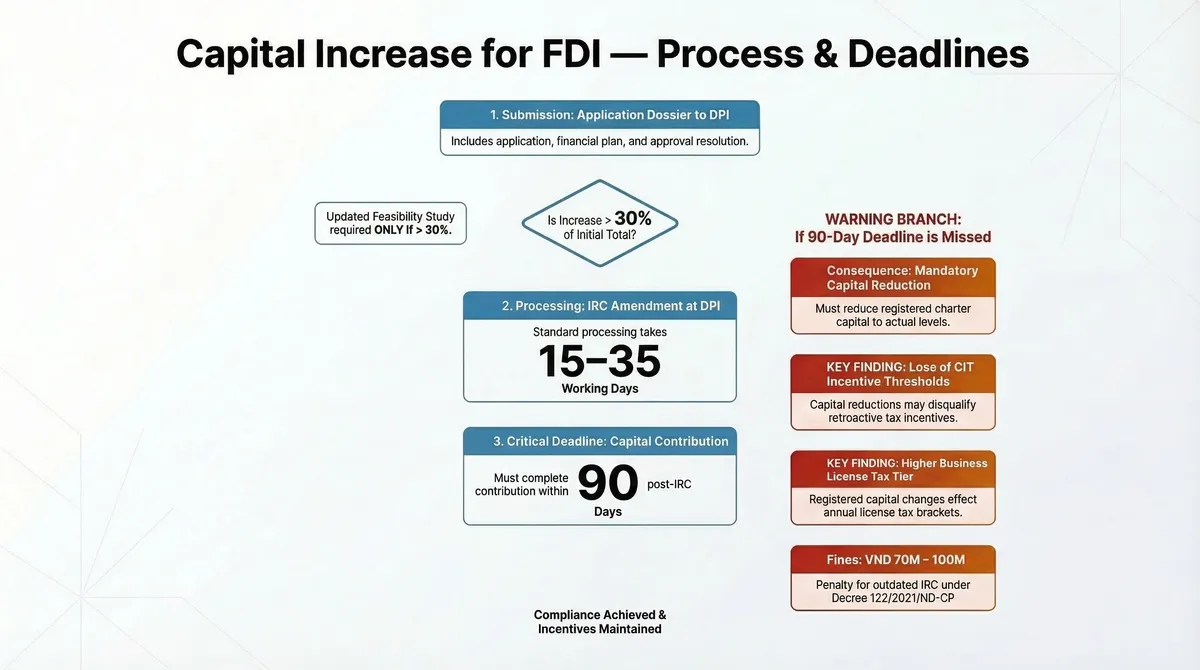
FDI capital increases and decreases require IRC amendment at Department of Finance (formerly DPI) within 15-35 working days, with the exact timeline depending on whether the change triggers an investment policy adjustment under the Investment Law Article 33.
Four documents form the standard dossier:
- Application for IRC adjustment (per Circular 25/2023/TT-BKHDT, amending Circular 03/2021/TT-BKHDT)
- Updated investment project financial plan showing the source and deployment schedule of additional capital
- Resolution of the Member’s Council or General Meeting of Shareholders approving the increase
- Updated project feasibility study — required when the increase exceeds 30% of initial total investment
Department of Finance (formerly DPI) reviews capital increases against the company’s track record. Companies that haven’t fully disbursed their original charter capital face additional scrutiny — Department of Finance (formerly DPI) questions why existing capital remains undeployed before approving more.
One detail that catches growing companies: capital contributions must be completed within the schedule specified in the amended IRC. Most amended IRCs allow 90 days. Missing that deadline triggers mandatory adjustment — the company must reduce its registered charter capital to match actual contributions and update capital contribution ratios accordingly (Enterprise Law, Law 59/2020/QH14 Articles 47-48). That reduction can affect CIT incentive thresholds and Business License Tax tier.
Capital Decrease
FDI capital decreases take 15-25 working days at Department of Finance (formerly DPI). The review is more intensive because Department of Finance (formerly DPI) focuses on creditor and employee protection.
Required documents:
- Latest audited financial statements showing net asset position exceeds post-decrease charter capital
- Written confirmation from the legal representative that all debts are settled or adequately provisioned
- Evidence that creditors have been notified of the proposed decrease
- Tax clearance or confirmation from the provincial tax authority of no outstanding obligations
Department of Finance (formerly DPI) evaluates three things: whether creditors are adequately protected, whether remaining capital sustains continued operations, and whether any conditional business line minimum capital requirements still hold. Rejection is discretionary — Department of Finance (formerly DPI) can refuse if the decrease appears to endanger stakeholder interests.
Capital decreases don’t necessarily mean returning funds overseas. They often reflect accumulated losses, business downsizing, or post-M&A restructuring where the entity retains capital but adjusts its registration to match economic reality.
Business Activity Changes
Adding Standard Business Lines
Adding new VSIC codes (Vietnam Standard Industrial Classification) to the IRC follows the standard 15-35 day amendment timeline at Department of Finance (formerly DPI). Each new activity must match the correct 4-digit VSIC code from the classification system maintained by the General Statistics Office.
Before filing, verify whether your new activity qualifies as a conditional business line. The Investment Law’s Appendix IV currently lists over 200 conditional business lines across sectors including food production, pharmaceuticals, education, financial services, and telecommunications.
Adding Conditional Business Lines
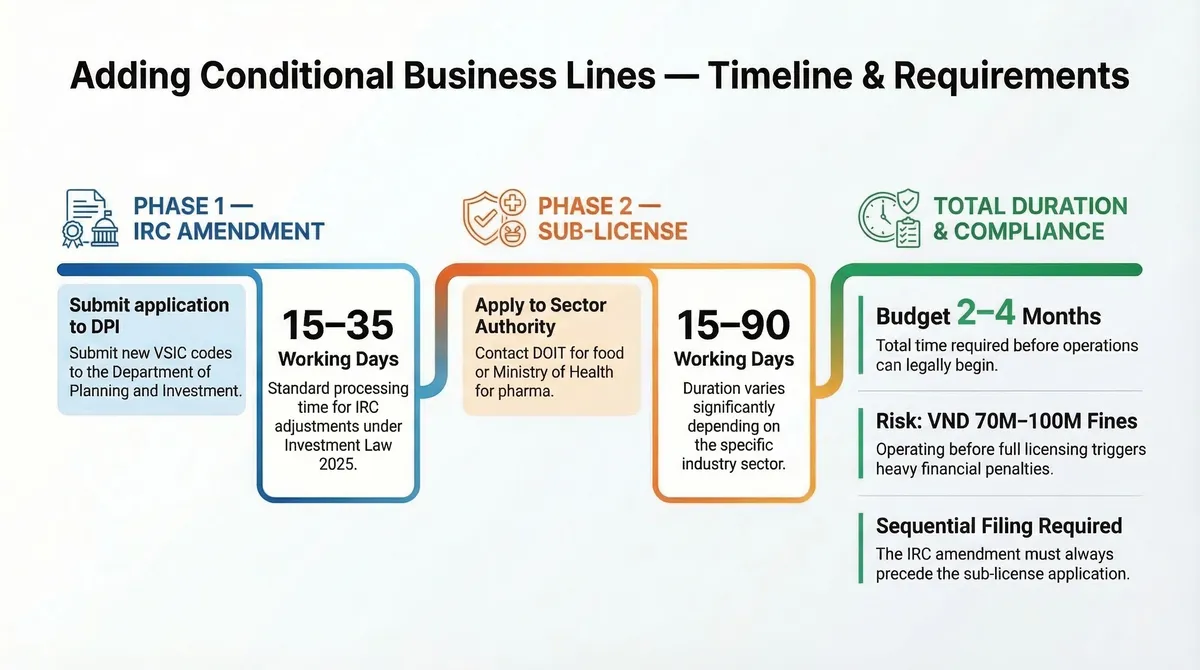
Conditional activities require both IRC amendment and a sector-specific sub-license — and the sub-license often takes longer than the IRC change:
- IRC amendment adding the VSIC code at Department of Finance (formerly DPI) (15-35 working days)
- Sub-license from the relevant sector authority (15-90 working days depending on sector)
Food manufacturing requires a DOIT sub-license. Pharmaceutical distribution goes through the Ministry of Health. Telecommunications services need Ministry of Information and Communications approval. Education services require Ministry of Education licensing. Retail with multiple outlets requires an Economic Needs Test (ENT) under EVFTA/CPTPP commitments.
Budget 2-4 months from initial IRC amendment filing to sub-license issuance. The sub-license requirement catches companies off guard — many assume the amended IRC authorizes immediate operations in the new activity line.
Legal Representative Changes
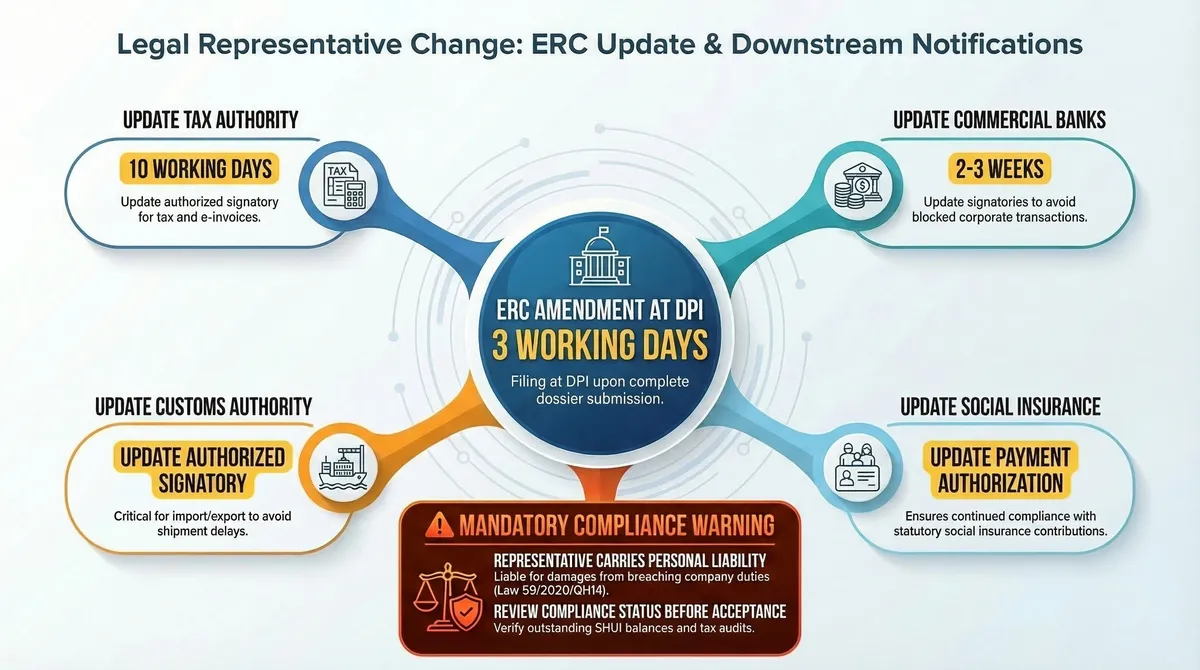
Legal representative changes require only ERC amendment at Department of Finance (formerly DPI) — 3 working days from complete dossier submission. No IRC amendment is needed unless the individual also serves as the project representative named in the IRC.
Required documents:
- Notification of legal representative change (standard form)
- Appointment/removal resolution of the Member’s Council
- ID documents (passport, visa, TRC) of the new representative
- Work permit of the new representative (if foreign national) — or exemption confirmation under Decree 219/2025/ND-CP Article 7
What slows the process isn’t the Department of Finance (formerly DPI) filing itself but the downstream notifications. After ERC amendment, each of these updates must happen separately:
- Tax authority — update authorized signatory for tax returns and e-invoices (10 working days)
- Banks — update authorized signatories for all corporate accounts (varies by bank — often 2-3 weeks)
- Customs — update authorized signatory for customs declarations, if applicable
- Social Insurance — update payment authorization at provincial SHUI office
The legal representative carries personal liability for damages caused by breaching duties to the company (Enterprise Law, Law 59/2020/QH14 Article 13 Clause 2). Incoming representatives should review the company’s compliance status — including pending tax audits and outstanding SHUI balances — before accepting the appointment.
Post-Amendment Compliance
After any IRC or ERC amendment, downstream updates follow a mandatory sequence. Missing these creates practical problems that surface months later: tax returns rejected for signature mismatches, bank transfers blocked for unauthorized signatories, customs clearance delayed for outdated credentials.
| Action | Timeline | Authority |
|---|---|---|
| Update corporate seal (if company name changed) | 10 working days | Police/seal registration |
| Update tax registration | 10 working days | Provincial tax authority |
| Update bank account signatories | 2-3 weeks | Commercial bank |
| Publish amendment on business registration portal | Automatic | NBRS |
| Notify Department of Finance (formerly DPI) for investment activity reporting | Next quarterly report | Department of Finance (formerly DPI) |
| Update digital certificate and e-invoice authorization | 30 working days | Digital certificate provider |
Common Mistakes
Starting new activities before the amendment is issued. Operating a business activity not listed on the current IRC violates the Investment Law. Tax authorities can disqualify CIT incentives for any period where actual activities don’t match the IRC — and that disqualification applies retroactively.
Updating one certificate but not the other. Amending the IRC without updating the ERC (or vice versa) creates certificate discrepancies. These surface during tax audits, bank compliance reviews, and M&A due diligence — generating delays and additional costs at the worst possible moments.
Not checking foreign ownership restrictions. Vietnam maintains sector-specific foreign ownership caps under the WTO Commitments and the Investment Law’s Negative List. Adding a restricted activity to the IRC triggers automatic rejection. Some activities allow foreign ownership only up to 49% or 51% depending on applicable FTA commitments.
Underestimating conditional business line timelines. IRC amendment: 15-35 days. Sub-license: 15-90 days. Total: 2-4 months before operations can begin. Companies that plan conditional line additions into quarterly business targets should start the process well before the target quarter.
For corporate amendment filings, conditional business line licensing, and post-amendment compliance coordination — Indochina Link’s company formation and licensing service covers the full IRC/ERC amendment process.
This guide reflects corporate amendment procedures as of March 2026 under the Investment Law (Law 143/2025/QH15, effective 1 March 2026), Enterprise Law (Law 59/2020/QH14), and Decree 01/2021/ND-CP. Implementing decrees under the Investment Law 2025 are being issued progressively — verify current dossier requirements with the provincial Department of Finance (formerly DPI) before filing.