







Vietnam’s conditional business line framework controls which sectors foreign investors can enter—and under what restrictions. Appendix IV of the Law on Investment 2025 (effective March 1, 2026) lists sectors subject to foreign ownership caps, mandatory licensing, or outright prohibition. Decree 31/2021/ND-CP Annex I contains over 200 conditional business lines across multiple economic sectors.
That list is shrinking. The Law on Investment 2025 removes 38 conditional business lines—primarily in manufacturing, wholesale, and IT services—shifting them from pre-licensing approval to ex-post supervision. For investors in still-conditional sectors, the full framework remains in force. For investors in deregulated sectors, market entry timelines compress dramatically.
The following sections explain the Negative List system, the 2025-2026 reforms, and the compliance pathway for entering a conditional sector. For the full Vietnam market entry roadmap, see the complete guide to doing business and setting up a company in Vietnam.
Key takeaways
- Vietnam’s Negative List (Appendix IV) defines conditional sectors — all other sectors are open to 100% foreign ownership.
- The Law on Investment 2025 (eff. March 1, 2026) abolishes 38 conditional lines — manufacturing, wholesale, IT services shift to ex-post supervision.
- Still-conditional sectors require IRC + sectoral license. Aviation caps at 34%, banking at 30%, telecommunications at 49%.
- Abolished sectors skip the IRC entirely — enterprise registration + notification only, timeline drops to 7–10 business days.
- Verify sector classification with MPI before committing capital — provincial-level conditions may apply beyond the national list.
The Negative List: What Foreign Investors Face
Every sector in Vietnam is open to foreign investment unless Appendix IV says otherwise—the core principle under the Law on Investment 2025. The sectors that ARE restricted fall into two categories: prohibited (narcotics production, certain defense industries—no foreign participation allowed) and conditional (foreign participation allowed with restrictions).
Conditional sectors restrict foreign investor access through three mechanisms.
Foreign Ownership Caps
Many sectors limit how much equity foreign investors can hold. Telecommunications services were previously capped at 49% under Decree 25/2011/ND-CP. Ownership limits now depend on the specific telecom service category and applicable international treaties (Law on Telecommunications 2023, No. 24/2023/QH15, effective July 1, 2024; Decree 100/2024/ND-CP).
Aviation caps at 34% (Decree 89/2019/ND-CP). Certain logistics subsectors allow 51% under Decree 163/2017/ND-CP, as amended by Decree 90/2020/ND-CP. These caps determine whether foreign investors can operate independently or need a Vietnamese partner—structuring around ownership caps through informal arrangements carries serious legal risk including license invalidation.
Sector-Specific Licensing
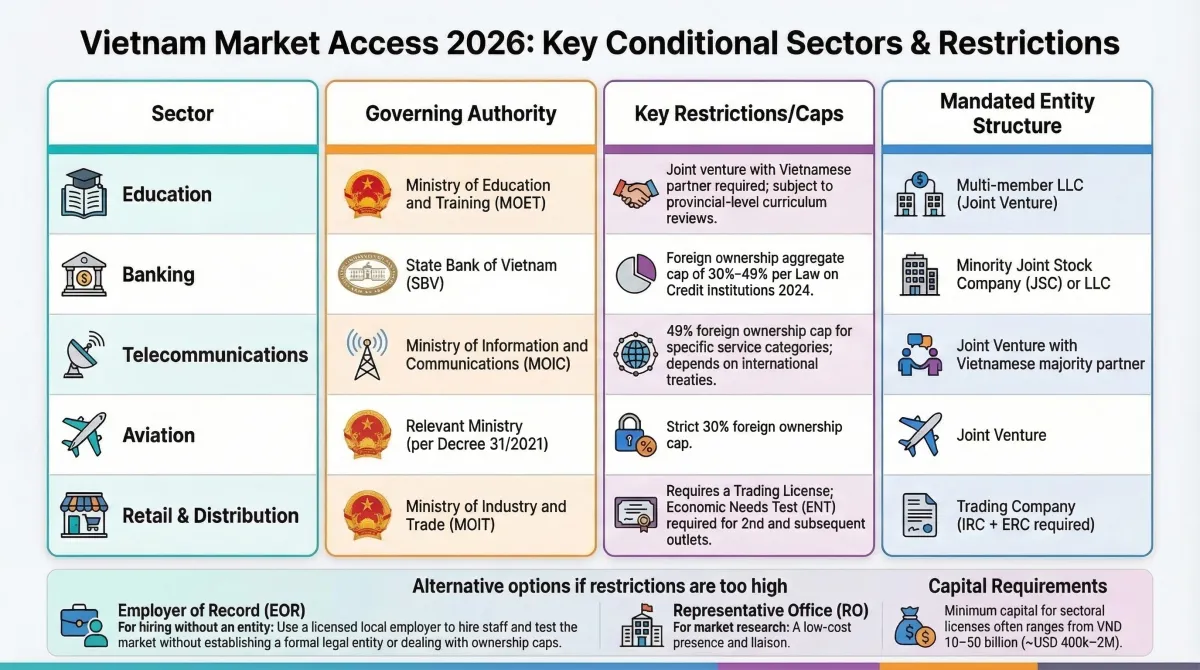
The Investment Registration Certificate (IRC) confirms investment approval. It doesn’t authorize operations. Conditional sectors require additional licenses from the governing ministry—telecommunications licenses from the Ministry of Information and Communications, educational permits from the Ministry of Education and Training, banking licenses from the State Bank of Vietnam (SBV). Each sectoral license imposes its own capital requirements, technical standards, and reporting obligations.
Economic Needs Tests
Some sectors apply market access quotas. Retail distribution historically required an economic needs test (ENT) for second and subsequent outlets under Decree 09/2018/ND-CP, as amended by Decree 67/2021/ND-CP. These tests evaluate whether the proposed business fills a genuine market need—authorities in Ho Chi Minh City (HCMC) historically applied stricter interpretations than Hanoi for retail ENTs.
| Sector | Governing Authority | Key Restriction |
|---|---|---|
| Telecommunications | Ministry of Information and Communications | Per Law on Telecommunications 2023 (No. 24/2023/QH15) and Decree 100/2024/ND-CP — varies by service category |
| Banking | State Bank of Vietnam | Foreign ownership limits per Law on Credit Institutions 2024 (No. 32/2024/QH15); confirm current caps from SBV |
| Education | Ministry of Education and Training | Joint venture with Vietnamese partner required |
| Retail | Ministry of Industry and Trade | ENT for second+ outlet (Decree 09/2018/ND-CP) |
The principle: Appendix IV defines WHETHER the sector is conditional. Sectoral decrees define HOW to comply. Always cross-reference both before committing capital.
2025-2026 Reforms: What Changes and What Stays
The Law on Investment 2025 delivers the largest deregulation of conditional business lines since Vietnam’s WTO accession, removing conditional status from sectors posing minimal risk to national defense, financial stability, or social values. Resolution 66/NQ-CP (26 March 2025) supports broader administrative procedure simplification across these reforms.
Sectors Losing Conditional Status
The abolished lines concentrate in manufacturing (food processing, textile production), wholesale trade of non-sensitive goods, professional services (architectural consulting, market research), logistics subsectors (warehousing, freight forwarding), and information technology services (software development, data processing).
Why these sectors? They don’t implicate national security or financial system risk. The government shifts from approving every foreign investment upfront to monitoring operations after establishment. For investors in these sectors, the change eliminates IRC requirements and cuts market entry timelines dramatically.
Sectors Remaining Conditional
Sensitive sectors stay strictly controlled: telecommunications infrastructure, media and publishing, banking and finance, natural resources extraction, real estate development, and education. These sectors affect national security, financial stability, or cultural values—areas where Vietnam maintains tight oversight regardless of reform trends.
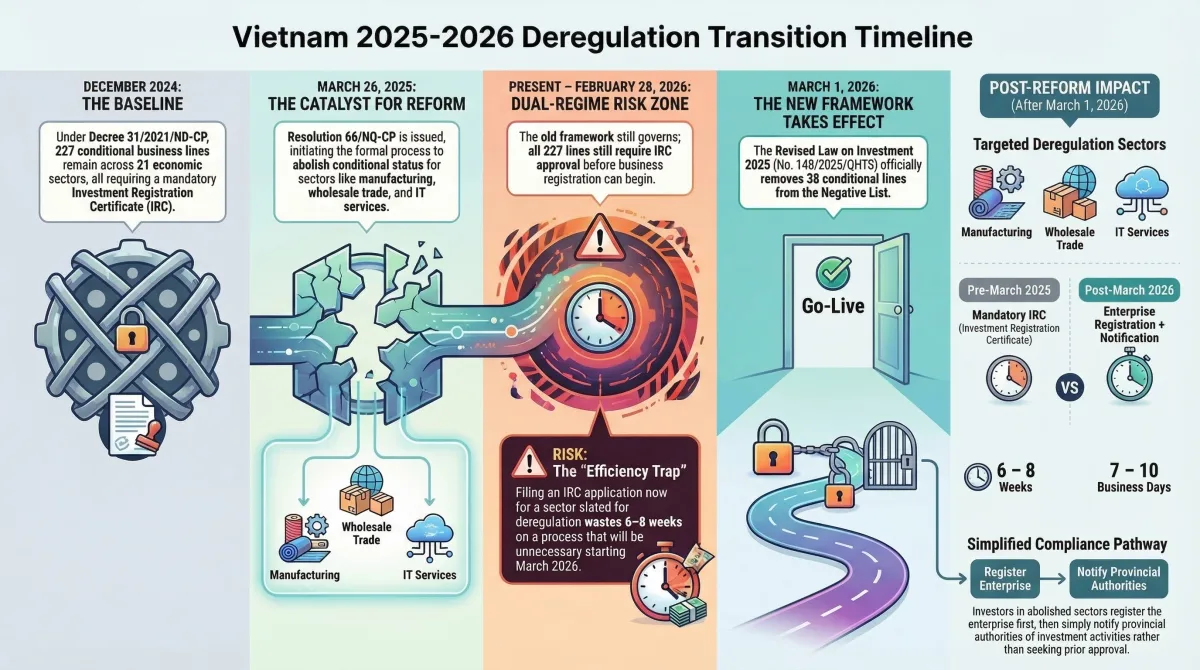
If the target sector remains on the post-reform Negative List, every current restriction still applies. Ownership caps don’t change. Sectoral licensing requirements don’t change. The only thing that changes is the list gets shorter. MPI’s updated Appendix IV reflecting the 38 abolished sectors took effect March 1, 2026.
The Transition: Dual-Regime Risk
Before March 1, 2026, the previous framework under Decree 31/2021/ND-CP Annex I governed all conditional sectors. All listed sectors required IRC approval from the Ministry of Planning and Investment (MPI) or provincial Department of Finance (formerly Department of Finance (formerly DPI)) per Articles 33-35 before the investor could register the business.
From March 1, 2026, the new framework applies. Investors in abolished sectors register their enterprise first through standard business registration, then notify provincial authorities of investment activities—notification, not approval. Timeline drops from 6–8 weeks to roughly 2–4 weeks for deregulated sectors.
The compliance risk remains relevant for investors mid-process: starting operations without IRC in a sector that is still conditional triggers regulatory violations with penalties under applicable administrative sanction decrees. Foreign investors should verify sector classification with MPI’s official portal before committing to either pathway.
Compliance Pathway: Entering a Conditional Sector
FDI companies in still-conditional sectors after March 2026 follow a two-stage process.
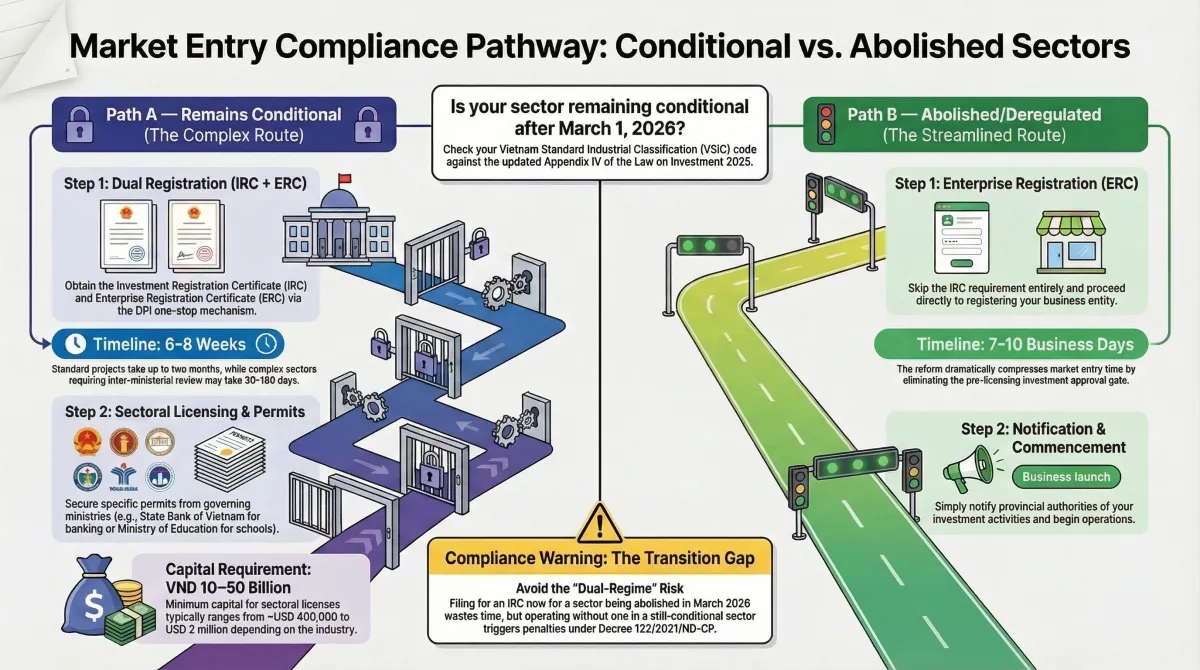
Stage 1: IRC and Enterprise Registration. Obtain both the IRC and ERC through the provincial Department of Finance (formerly DPI)’s one-stop mechanism. Processing takes 6–8 weeks for standard projects, 30–180 days for complex sectors requiring inter-ministerial review. For the complete procedure, see the foreign company registration guide.
Stage 2: Sectoral Licensing. After IRC, secure the sector-specific license: telecommunications from MICT (Law on Telecommunications 2023), banking from SBV (Law on Credit Institutions 2024), education from MOET plus provincial curriculum reviews. Minimum capital for sectoral licenses ranges from VND 10–50 billion (~USD 400,000–2 million) on top of charter capital. Conditional sector operations expand the legal representative’s personal liability scope—see legal representative liability risks.
Post-2026 Simplified Pathway. For abolished conditional lines, the IRC is no longer required from March 1, 2026. Register the enterprise, notify provincial authorities, commence operations—timeline compresses to roughly 7–10 business days. Complete corporate e-ID registration early to access government portals from day one.
When the Sector Is Conditional: What Comes Next
Retail and Distribution: The Most Common Conditional Sector
Retail distribution is the conditional license most FDI companies encounter. Foreign investors selling goods directly to Vietnamese consumers—whether through physical stores, e-commerce, or wholesale distribution—need a trading license on top of the IRC. The economic needs test for second and subsequent retail outlets adds another approval layer that varies by province.
For trading license requirements, ENT procedures, and retail distribution compliance, see Vietnam trading license requirements for foreign-invested retail and distribution companies.
Some Sectors Restrict the Choice of Entity
The sector restriction doesn’t just limit ownership—it can determine entity type entirely. Education requires a joint venture with a Vietnamese partner, which forces a multi-member LLC structure. For multi-member LLC charter provisions, governance requirements, and member council voting rules, see LLC governance structure and ownership framework for foreign investors.
Banking caps mean foreign investors can’t hold controlling stakes, affecting whether to form an LLC or pursue a minority JSC position. Sectors with 49% caps require Vietnamese partners who hold majority equity, shifting governance dynamics regardless of investor preference.
Before choosing an entity structure, check whether the conditional sector narrows the options. See LLC vs. JSC vs. representative office vs. branch structures for foreign investors in Vietnam.
Sector Restrictions Too High? Consider EOR as an Alternative
Sometimes ownership caps, capital requirements, or licensing complexity make direct entry impractical. An EOR lets you hire Vietnamese employees through a licensed local employer. A Representative Office gives you a physical presence for market research without revenue-generating activity. Both give you time to evaluate the market while conditional sector applications process. See representative office vs. EOR for market entry without incorporation.
Verify Before You Commit
Vietnam’s conditional business line framework is changing faster than any period since WTO accession. Sectors that required IRC approval in 2024 may be fully deregulated by March 2026. Sectors that appear unrestricted may carry provincial-level conditions not published in the national Negative List.
One principle holds: verify sector classification before deploying capital. Check Appendix IV, cross-reference the sectoral decree, and confirm with MPI or the provincial Department of Finance (formerly DPI) whether the 2025 reforms affect the target sector. The cost of verification is a few days. The cost of getting it wrong is months of unnecessary licensing—or regulatory violations that threaten the entire investment. Before committing capital, also secure trademark registration in Vietnam—conditional sectors attract local registrations of foreign brand names, and Vietnam’s first-to-file system means losing the brand name to a squatter while waiting for licensing approval.
Need sector-specific guidance? Indochina Link Vietnam provides conditional business line compliance assessments, IRC application support, and sectoral licensing navigation for company registration for foreign investors across all Vietnamese provinces.
LEGAL DISCLAIMER
This article provides general information about Vietnam’s conditional business line framework. Regulations are subject to change—the 2025-2026 reform timeline involves multiple regulatory instruments with staggered effective dates. Always verify current sector classifications with the Ministry of Planning and Investment before committing capital. Foreign investors should consult licensed legal counsel for project-specific compliance guidance.