







Last updated: February 2026. Regulations current as of this date.
The entity structure choice locks in liability exposure, compliance costs, and operational flexibility for years. Get it wrong, and converting later means Investment Registration Certificate (IRC) amendments, charter restructuring, beneficial owner re-declaration, and 45–60 days of processing through the Department of Finance (formerly Department of Finance (formerly DPI))—plus cascading bank account and license updates that follow.
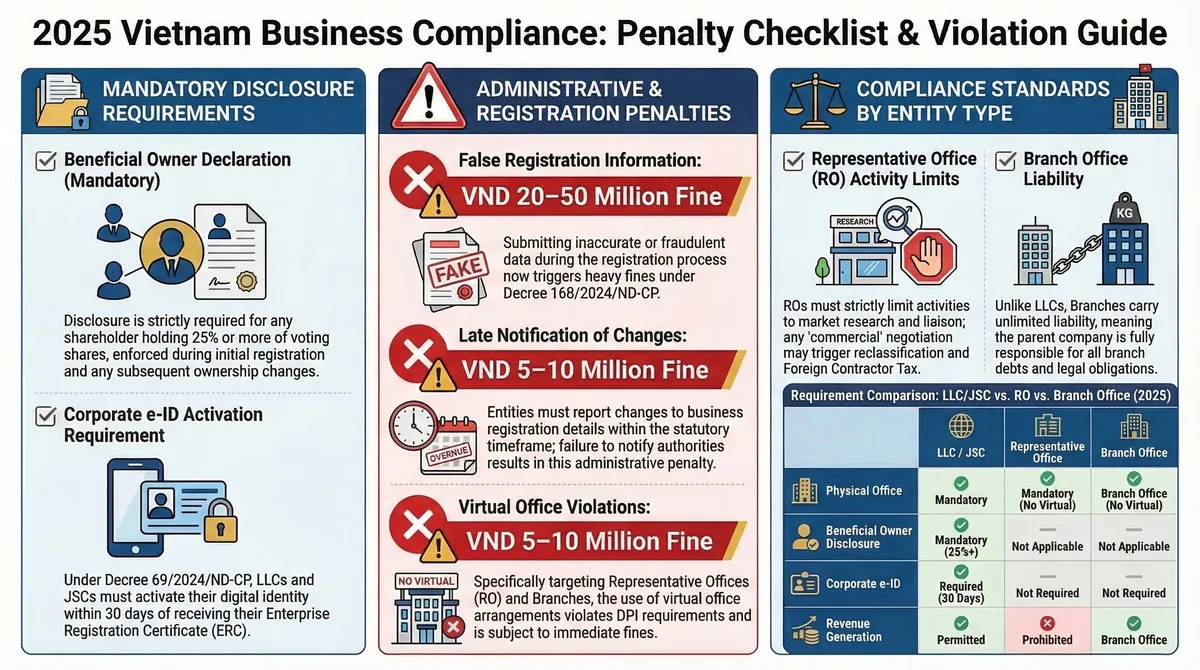
Vietnam’s Law on Enterprises 2020 (No. 59/2020/QH14, as amended by Law No. 76/2025/QH15, effective July 1, 2025) governs all four structures available to foreign investors: Limited Liability Company (LLC), Joint Stock Company (JSC), Representative Office (RO), and Branch Office. The 2025 regulatory cycle adds friction—corporate e-ID mandates under Decree 69/2024/ND-CP and beneficial owner disclosure under Decree 168/2025/ND-CP are stretching registration timelines by several weeks depending on document readiness.
The four Vietnam entity structures differ in cost, timeline, and risk exposure. For the full setup roadmap from entity selection through post-registration compliance, see the complete guide to doing business and setting up a company in Vietnam.
LLC vs. JSC vs. RO vs. Branch: The Real Trade-offs
Limited Liability Company (LLC)—The FDI Default
LLCs dominate foreign investment registrations because they pair limited liability with single-owner decision speed. A single-member LLC gives direct authority—no shareholder meetings, no board votes for routine capital changes. Single-owner decision authority means faster pivots when market conditions shift. Multi-member LLCs (2–50 members) split governance between a Members’ Council and chairperson but still move faster than JSCs requiring formal shareholder resolutions.
Charter capital minimums no longer apply to most sectors—but sector-specific thresholds remain. International freight forwarding requires VND 5 billion (~USD 200,000) minimum per Decree 163/2017/ND-CP. For detailed LLC governance, charter provisions, and ownership rules, see LLC structure for foreign investors.
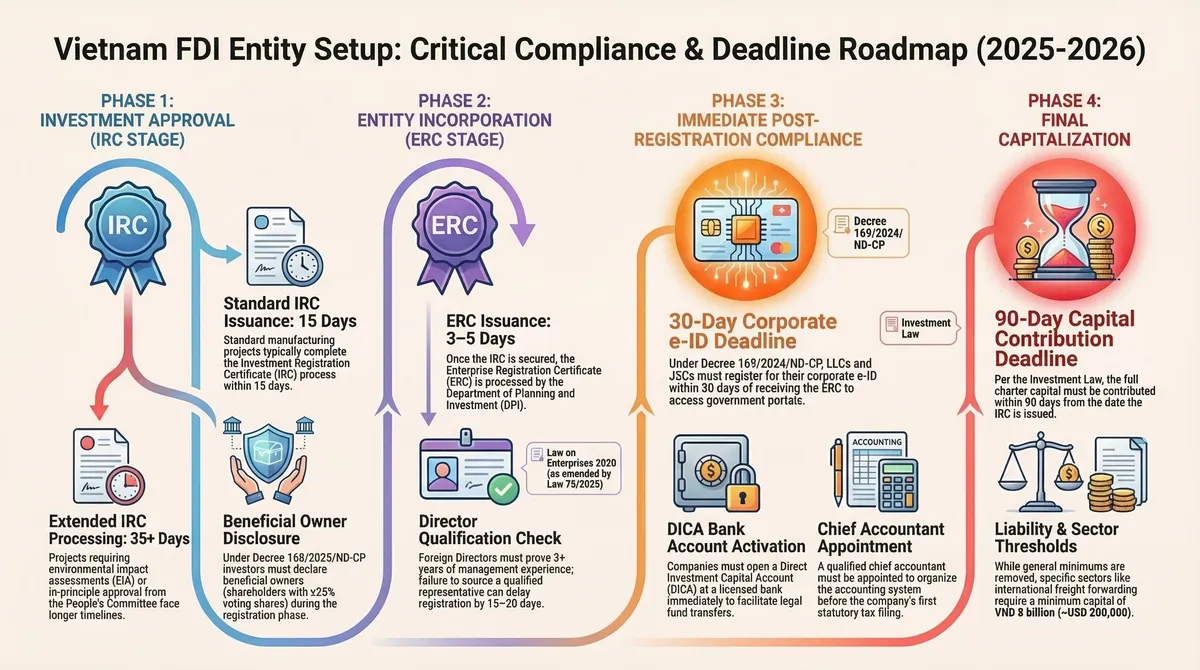
Directors must have either 3+ years of management experience or a valid work permit. Tax authorities cross-check CVs during ERC processing—applications get rejected when foreign Directors lack documented tenure, adding 15–20 days. The personal liability risks for foreign legal representatives go well beyond qualification checks.
Joint Stock Company (JSC)—When You Need Capital Flexibility
JSCs require 3+ founding shareholders. The trade-off: shares transfer freely (subject to charter restrictions), enabling investor exits without dissolving the entity. Right for joint ventures needing transparent equity splits or businesses targeting Series A funding within 36 months.
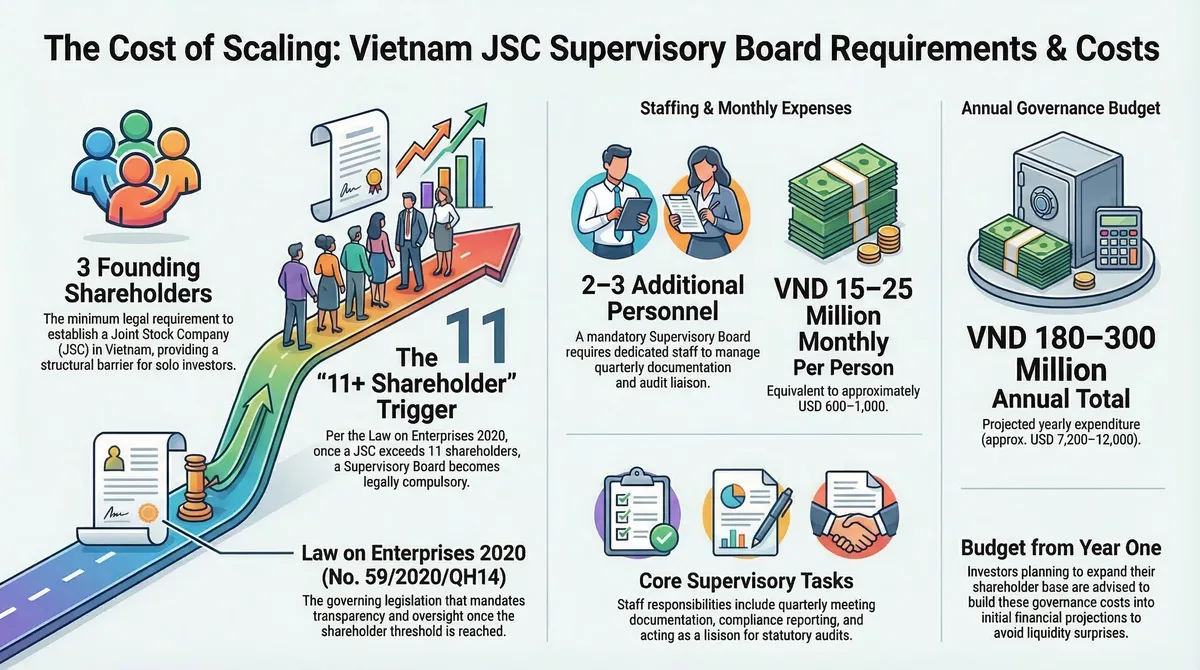
Once your shareholder count exceeds 11, a Supervisory Board becomes compulsory (Law on Enterprises 2020). That means 2–3 additional personnel at VND 15–25 million (~USD 600–1,000) monthly each, plus quarterly meeting documentation. Annual Supervisory Board costs reach VND 180–300 million (~USD 7,200–12,000) including personnel, audit liaison, and compliance reporting. Budget these from year one if you plan to expand beyond initial founders.
Converting LLC to JSC later requires both investment and enterprise registration amendments through Department of Finance (formerly DPI)—several weeks of processing plus advisory costs. Charter amendments, beneficial owner updates under Decree 168/2025/ND-CP, and bank account restructuring all cascade from the LLC-to-JSC conversion.
Representative Office (RO)—The “No Revenue” Constraint
ROs handle market research and liaison only—no contracts, invoices, or revenue. Many investors use the 6–12 month RO period to assess demand and build local relationships before full incorporation.
The trap: tax authorities aggressively audit ROs for Foreign Contractor Tax exposure. If RO staff negotiate deals—even when contracts get signed abroad—the GDT may reclassify those activities as taxable services. Keep activities strictly to research and liaison.
RO establishment takes 6–8 weeks via provincial Department of Finance (formerly DPI). No charter capital required. The Chief Representative must hold a university degree and relevant work experience—Department of Finance (formerly DPI) verifies education credentials against Ministry of Education databases. If RO restrictions feel too limiting, consider the RO vs. EOR comparison for market entry without incorporation.
Branch Office—Parent Company Extension
Branches generate revenue (unlike ROs) but carry unlimited liability—all branch debts become parent company obligations. Creditors can pursue enforcement against the parent company’s assets directly.
Branches are limited to the parent’s licensed scope under Article 45, Law on Enterprises 2020. Branch offices can only operate in business lines where 100% foreign ownership is permitted. Conditional sectors like retail, logistics, and education still require IRC approval—negating the “simpler than LLC” advantage. Works for project-based operations (construction, consulting) where the parent can absorb liability exposure.
Comparison Matrix
| Criteria | LLC | JSC | RO | Branch |
|---|---|---|---|---|
| Revenue Generation | ✓ | ✓ | ✗ | ✓ |
| Limited Liability | ✓ | ✓ | N/A | ✗ (parent liable) |
| Min. Charter Capital | Sector-dependent | Sector-dependent | None | None |
| IRC Required (FDI) | ✓ | ✓ | ✗ | ✗ |
| 100% Foreign Ownership | ✓* | ✓* | N/A | N/A |
| Registration Timeline | ERC: 3–5 days IRC: 15–35 days | ERC: 3–5 days IRC: 15–35 days | 7–10 days | 7–10 days |
*Subject to sector-specific foreign ownership caps. Standard manufacturing projects complete IRC in 15 days; projects requiring environmental impact assessments take 35+ days.
Most sectors are open to 100% foreign ownership via LLC or JSC under Vietnam’s WTO commitments. Conditional business lines require IRC approval from provincial Department of Finance (formerly DPI) before operations begin.
Manufacturing, IT services, and wholesale trade generally allow 100% foreign-owned enterprises. Ownership caps apply in sensitive sectors—certain education services, aviation (34% cap per Decree 89/2019/ND-CP), and specific securities activities. The company charter must list business lines matching the IRC—mismatches trigger registration rejection, and correcting codes after IRC issuance requires a formal amendment application.
Timeline varies by sector complexity. Standard manufacturing projects complete IRC in 15 days. Projects requiring environmental impact assessments or in-principle approval from the People’s Committee take 35+ days. Industrial zones require detailed investment capital source verification before issuing IRC.
When foreign ownership caps apply, joint ventures become the alternative. Due diligence matters: verify your Vietnamese partner’s ERC status via the National Public Service Portal—check for tax debts, pending litigation, and beneficial ownership transparency before finalizing any agreement. Department of Finance (formerly DPI) cross-checks beneficial owner declarations against capital contribution evidence, and inconsistencies trigger rejection with 5–7 days added while you source corrected documentation.
For the step-by-step IRC and ERC process, see foreign company registration in Vietnam.
Common Entity Selection Mistakes
“Our branch operates independently.” Separate bank accounts and local management don’t create limited liability. Your parent company remains fully liable for all branch obligations under the Law on Enterprises.
“We’ll use the RO to help close deals.” The moment RO staff assist with contract negotiations, the GDT can reclassify those activities as commercial services subject to Foreign Contractor Tax. Keep RO activities strictly to market research and liaison.
“We don’t need a local chief accountant yet.” Both LLCs and JSCs need a qualified chief accountant or accounting officer to organize the accounting system and sign statutory financial reports before your first tax filing. Delaying this appointment delays your tax registration. When qualified local candidates aren’t available, outsourced chief accountant services offer a compliant alternative.
“We chose a JSC for flexibility but didn’t budget for governance.” The Supervisory Board requirement kicks in at 11+ shareholders. If you’re planning to expand your shareholder base, build VND 180–300 million (~USD 7,200–12,000) in annual governance costs into your projections from day one.
After You Choose: Compliance by Entity Type
LLCs and JSCs must register for corporate e-ID within 30 days of ERC (Decree 69/2024/ND-CP)—the only way to access tax filings and government portals from July 2025. The foreign legal representative must complete personal identity verification before the company’s e-ID can activate, so Director availability directly controls the timeline.
All foreign-invested entities must open a Direct Investment Capital Account (DICA) at a licensed Vietnamese bank before contributing charter capital. Banks require the IRC and ERC before processing the application. The 90-day capital contribution deadline starts from IRC issuance, not when the bank account is ready—plan DICA setup immediately upon receiving ERC.
Conditional sectors require additional licenses beyond your IRC. Retail distribution requires a trading license from DOIT. Manufacturing in industrial zones needs environmental impact assessments. Education, healthcare, and logistics each carry additional permits that add weeks to your operational launch. The number of additional licenses surprises most first-time investors—some sectors require three or four separate approvals before you can legally operate. For the full list, see conditional business lines in Vietnam.
Choosing Your Entity Structure
LLC fits most FDI market entries: limited liability, operational flexibility, lower compliance overhead. Choose JSC only if you need capital-raising capability or plan a public listing within 36 months.
ROs suit market research phases but carry Foreign Contractor Tax risk if activities drift beyond liaison. Branches work for project-based operations backed by strong parent balance sheets—but unlimited liability makes this the wrong choice for risk-averse investors.
The 2025 regulatory environment means you need to plan for corporate e-ID timelines, beneficial owner documentation, and capital account setup before you file—not after.
Next Step: Contact Indochina Link Vietnam for entity structure assessment and formation advisory tailored to your sector, investment timeline, and ownership preferences. Our team handles IRC processing, corporate e-ID registration, and ERC applications across all Vietnamese provinces.
LEGAL DISCLAIMER
This article provides general information about Vietnamese entity structures for foreign investors. Business formation decisions involve complex legal, tax, and operational considerations specific to your industry, investment timeline, and corporate structure. Readers should consult qualified legal and tax advisors before making entity selection decisions. Vietnamese regulations change frequently—verify current requirements with professional advisors before initiating registration procedures.