








A Representative Office (RO) in Vietnam costs USD 3,000–5,000 annually but cannot generate revenue—Decree 07/2016/ND-CP Article 30 restricts operations to liaison, market research, and business promotion only. An Employer of Record (EOR) arrangement costs 8–25% of gross salary on top of employee compensation but enables full commercial operations—staff can sign contracts, close deals, and generate revenue under Labor Code 2019.
Setup timelines differ significantly: RO licensing takes 15–20 working days from document submission; EOR arrangements are operational within 7–15 working days from contract execution. Any commercial activity by an RO—even informal sales by local staff—violates Decree 07/2016/ND-CP and triggers license revocation plus potential deportation of the Chief Representative.
The choice depends on one question: does the Vietnam presence need to generate revenue?
Vietnam Market Entry Decision
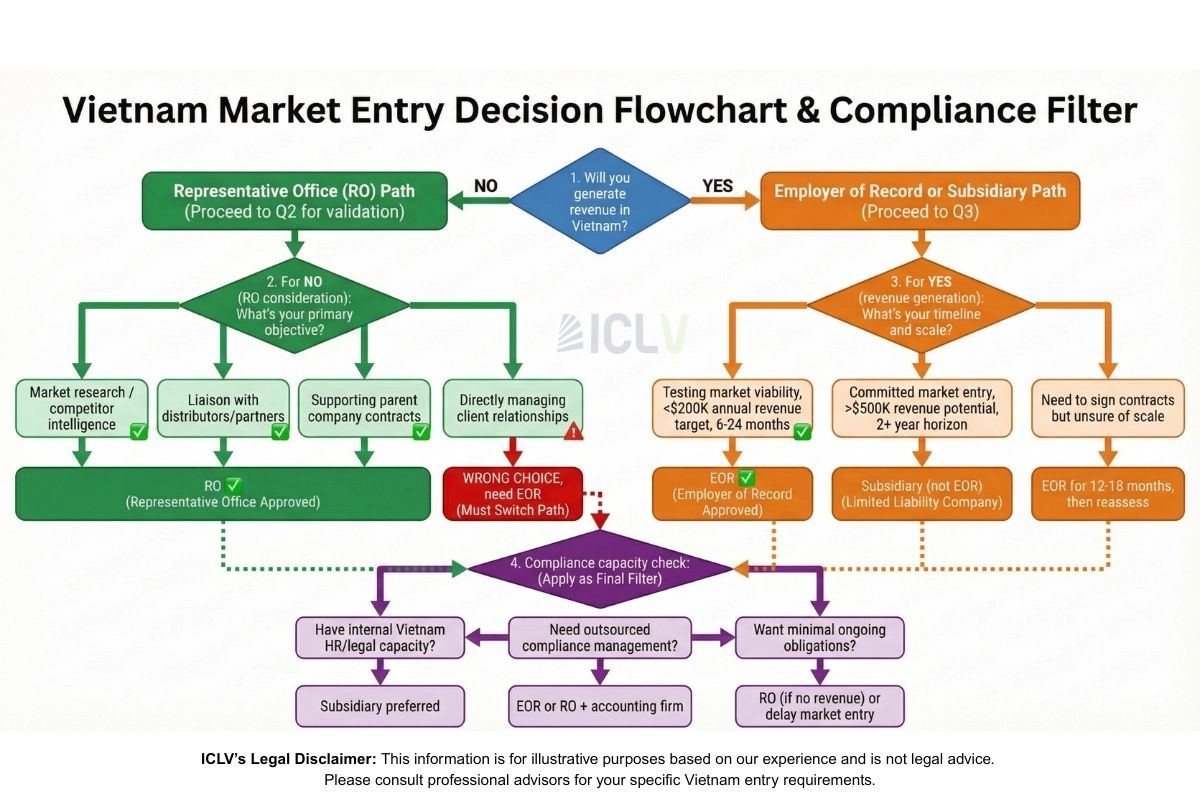
RO vs. EOR: The Legal Distinction
Representative Offices cannot generate revenue—Decree 07/2016/ND-CP Article 30 limits operations to liaison functions, market research, and business promotion only. The RO cannot enter into contracts, issue invoices, or conduct any profit-making activities in Vietnam
Employer of Record arrangements enable commercial operations—staff can sign contracts and generate revenue under Labor Code 2019’s labor outsourcing framework (Articles 52-54). A Vietnamese EOR entity employs staff on the client’s behalf, handling payroll, Social Insurance, PIT declarations, and Work Permits while the client directs sales, project delivery, and client management.
| ⚠️ COMPLIANCE ALERT: RO conducting ANY commercial activity violates Decree 07/2016/ND-CP Article 30. Parent company must sign all contracts. Violation penalties include Representative Office License revocation and potential deportation of the Chief Representative under immigration law. |
|---|
What an RO Can and Cannot Do
Representative Offices cannot generate revenue whatsoever. Permitted activities include market research, liaison with partners, promoting the parent company’s brand, and supervising contracts signed by the parent company abroad. Prohibited activities include signing contracts, generating revenue, direct sales or invoicing, and hiring for commercial operations.
The common trap: assuming an RO can “test the market” with small sales. This violates Decree 07/2016/ND-CP.
In practice, the Department of Industry and Trade scrutinizes Annual Reports for signs of commercial activity. If the RO staff are closing deals or issuing invoices—even informally—the parent company is exposed. Understanding Vietnam business entity structures is essential before committing to any setup.
| Permitted Activities | Prohibited Activities |
|---|---|
| Market research | Signing contracts |
| Liaison with partners | Generating revenue |
| Promoting parent company | Direct sales/invoicing |
| Supervising contracts signed by parent | Hiring for commercial operations |
Circular 11/2016/TT-BCT provides standard forms for representative offices, while the activity restrictions come from Decree 07/2016/ND-CP Article 30—liaison, market research, and promoting the parent company’s business opportunities only.
EOR: The Revenue-Generating Alternative
The EOR model solves the revenue problem. Here’s how it works:
- The EOR provider employs the client’s staff legally—the client directs their work.
- The client defines roles, assigns tasks, and manages day-to-day operations.
- The EOR handles compliance: Social Insurance enrollment per Law 41/2024/QH15, quarterly Personal Income Tax declarations under Circular 80/2021/TT-BTC, Work Permit applications per Decree 152/2020/ND-CP, and annual audits.
The client directs the work. The EOR bears the compliance liability.
Hidden Cost Alert: EOR fees typically run 8-25% on top of gross salary based on market surveys of Vietnam providers. For a $3,000/month employee, expect $450-$750 monthly in service fees. Factor this into the cost comparison against full incorporation. For investors considering traditional incorporation routes, reviewing foreign direct investment process requirements alongside EOR options provides useful perspective.
In practice, EOR works best for:
- Sales teams needing to sign contracts locally
- Project-based engagements (6-18 months)
- Testing market viability before committing to a subsidiary
Decision Matrix: RO vs. EOR
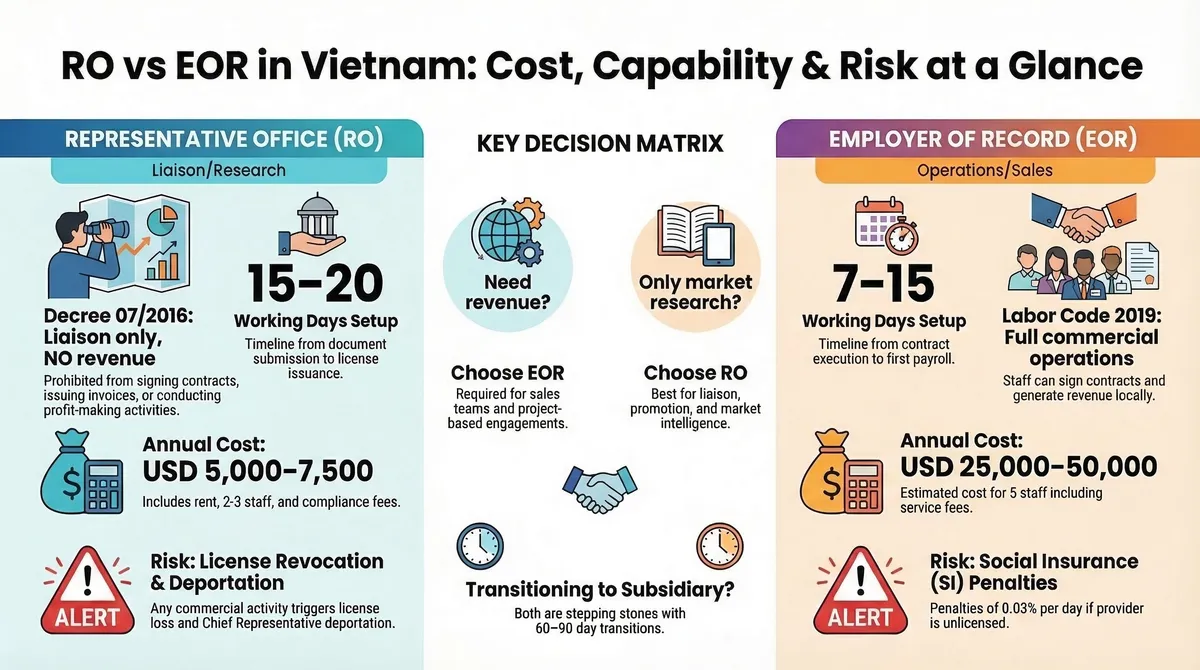
| Factor | Representative Office | Employer of Record |
|---|---|---|
| Revenue generation | ❌ Prohibited | ✅ Yes |
| Hiring employees | ✅ Limited (support staff) | ✅ Full commercial teams |
| Setup time | 15-20 working days from document submission to license issuance | 7-15 working days from contract execution to first payroll |
| Annual compliance | Report to Dept. of Industry & Trade | Handled by EOR provider |
| Estimated annual cost | VND 120-180M (~USD 5,000-7,500): Office rent, 2-3 local staff, Business License Tax, compliance | VND 600M-1.2B (~USD 25,000-50,000): 3-4 staff + 8-25% EOR fees, Social Insurance, full payroll overhead |
| Best for | Market research, liaison | Sales teams, project-based work |
Note: Costs vary by location (HCMC vs Hanoi vs provinces) and salary levels. Estimates reflect 2026 market rates.
The Compliance Traps in Each Model
For Representative Office:
- Annual Report Deadline: End of January per Circular 11/2016/TT-BCT Article 9. Miss it, and the Department of Industry and Trade flags your license for review. Repeated violations trigger revocation proceedings.
- License Renewal: File 30 days before expiry. Late filing suspends operations immediately.
- Work Permits: All foreign staff of Representative Offices, including the Chief Representative, require Work Permits per Decree 219/2025/ND-CP (effective August 2025, replacing Decree 152/2020/ND-CP) unless they qualify for exemption under one of 15 categories listed in Article 7 (e.g., intra-company transferees, certain service providers). Note: the previous VND 3 billion capital contributor exemption under Decree 152 has been removed.
- Work Permit Timeline: Plan 15-20 working days for Work Permit processing from complete dossier submission. The Chief Representative bears personal liability similar to a legal representative for all RO activities—understand these risks before appointing a nominee.
For EOR:
- Provider Verification: Confirm the EOR’s legal standing by requesting their Labor Services License (Giấy phép Hoạt động dịch vụ việc làm) issued by the Department of Labor per Decree 145/2020/ND-CP. Verify license number at the MOLISA online portal or request certified copies of their business registration and labor service permit.
- Unlicensed EOR Risk: Unlicensed providers expose the company to Social Insurance penalties and employee disputes. If transitioning from EOR to subsidiary, appointed resident legal representative and outsourced chief accountant services may be necessary during the setup period.
- Social Insurance Enrollment: Must occur within 30 days of employment start—Law 41/2024/QH15 Article 17 requires this. The 2024 Social Insurance Law (Law 41/2024/QH15) changed the penalty rate to 0.03% per day, effective July 1, 2025.
- Quarterly PIT Declarations: The EOR files these under Circular 80/2021/TT-BTC, but the client remains liable if the provider fails. Request copies of submission receipts quarterly.
| ⚠️ RISK ALERT: Commercial activities by RO violate Decree 07/2016/ND-CP Article 30. Penalties include license revocation and deportation of responsible personnel under Law 47/2014/QH13 immigration provisions. In HCMC, tax authorities cross-reference bank transactions with Annual Reports—discrepancies trigger audits and potential criminal investigations for tax evasion. |
|---|
RO Establishment: Quick Reference
For companies choosing an RO, here’s the streamlined process.
Core Documents
- Application Form MĐ-1: Standard template from the Business Registration Authority.
- Letter of Appointment for Chief Representative: Must specify full name, nationality, passport number, and scope of authority.
- Office Lease Agreement: Notarized Vietnamese translation required. Lease term must cover the RO’s operational period.
- Legalized Parent Company Certificate: Must show 1+ year of operation. Requires consular legalization or apostille per Hague Convention.
- Power of Attorney: If using a local agent for submission.
Post-Licensing Checklist
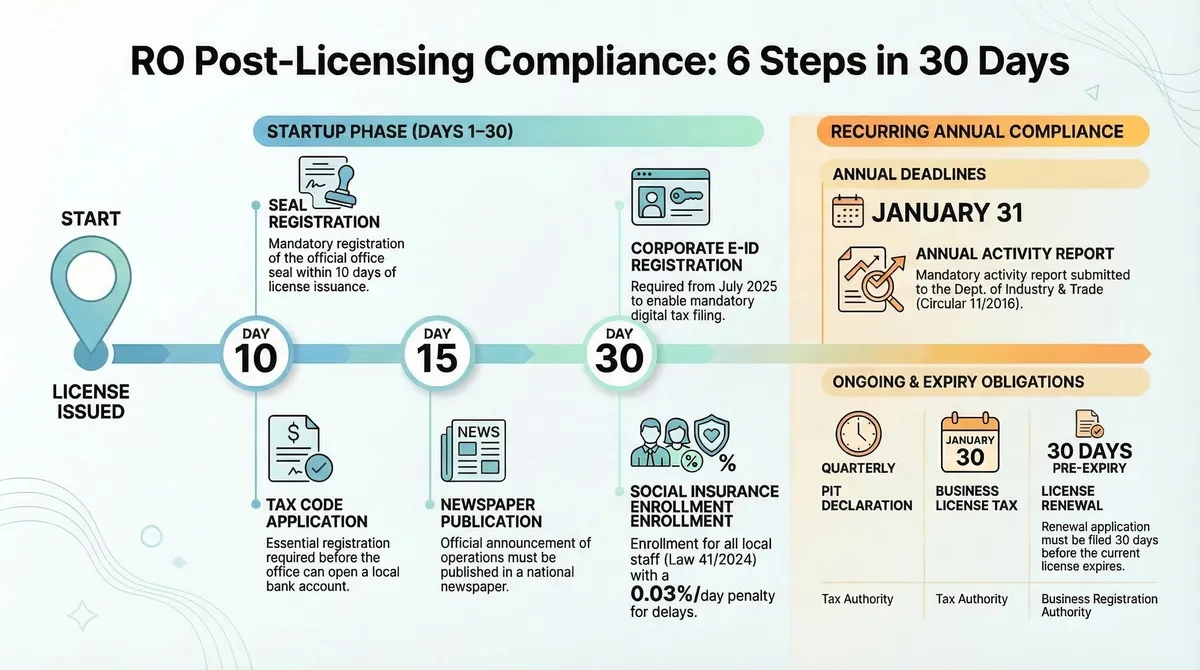
- Seal Registration: Within 10 days of license issuance.
- Tax Code Registration: Apply within 10 days. Required for opening a bank account.
- Work Permit Applications: For all foreign staff (except exempt Chief Representative under specific conditions).
- Corporate e-ID Registration: Required for digital tax filing and BRO submissions from July 2025.
- Operational Announcement: Publish in a national newspaper within 30 days.
- Social Insurance Enrollment: For local staff within 30 days of hire.
Tax & Compliance Deadlines
Annual Obligations Calendar
| Deadline | Obligation | Authority |
|---|---|---|
| January 31 | Annual Activity Report | Dept. of Industry & Trade |
| Quarterly (20th of month following quarter) | Personal Income Tax declaration | Tax Authority |
| 30 days before expiry | License Renewal application | Business Registration Authority |
| January 30 | Business License Tax | Tax Authority |
Work Permit Exemption Verification
Chief Representatives may qualify for Work Permit exemption under Decree 219/2025/ND-CP when appointed as a director or senior manager of the parent company with official documentation filed with DOLISA. Note: the 90-day stay limitation applies to visa requirements, not the work permit exemption itself—consult current regulations for the latest criteria.
All other foreign staff require Work Permits—no exceptions per Decree 219/2025/ND-CP. Processing takes 15-20 working days from complete dossier submission, so plan hiring timelines accordingly. For more details on regulatory frameworks, consult Vietnam sector-specific regulations relevant to your industry.
Your Decision Framework
RO = presence without revenue. EOR = revenue without entity. Choose based on your operational intent, not just cost.
EOR Employment Compliance: Whether through EOR or direct hiring, Vietnam’s employment obligations apply equally—labor contracts, SHUI, and termination rules cannot be sidestepped through EOR arrangements. The EOR provider handles work permits for foreign employees and payroll including gross-to-net calculations with SHUI, but the client remains operationally responsible for directing the work.
Tax Implications: Both RO and EOR structures carry distinct tax obligations. ROs must file quarterly PIT for local staff and face Foreign Contractor Tax (FCT) risk if the parent company receives service income attributable to Vietnam. EOR arrangements shift CIT and VAT filing to the provider, but the parent company should verify that EOR fees qualify as deductible expenses and do not trigger Permanent Establishment exposure. For the full CIT, PIT, and VAT framework applicable to FDI operations, see Vietnam Tax System: What Every FDI Enterprise Must Know.
Transition Path: Most investors view RO and EOR as stepping stones to full subsidiary incorporation. RO-to-subsidiary transition takes 30–45 days (Decree 01/2021/ND-CP). EOR-to-subsidiary preserves employee seniority via labor contract novation under Labor Code 2019. Factor 60–90 days total transition into your market entry roadmap.
Indochina Link provides compliant RO setup services and vetted EOR partnerships. Contact us for a consultation tailored to your business model.
⚖️ LEGAL DISCLAIMER: This guide provides general information about Vietnam’s Representative Office and Employer of Record structures current as of January 2026. Content does not constitute legal, tax, or professional advice. Regulations change frequently—consult qualified legal and tax advisors for your specific circumstances before making entity structure decisions.