







Vietnam’s LLC governance splits decision power between the Members’ Council and the Director under Law on Enterprises 2020 (No. 59/2020/QH14, as amended by Law No. 76/2025/QH15, effective July 1, 2025). The Council controls charter amendments, capital changes, and Director appointments through voting thresholds of ≥65% for ordinary resolutions and ≥75% for special resolutions per Article 59. The Director manages daily operations within limits the charter defines.
Note: LLC governance is governed by the Law on Enterprises 2020 (as amended). Investment registration for foreign-invested LLCs now follows the Law on Investment 2025 (No. 143/2025/QH15, effective March 1, 2026).
Get the charter wrong, and you’re stuck—post-registration amendments need 75% Members’ Council approval. Foreign investors must negotiate voting thresholds, authority limits, deadlock resolution, and exit rights before submitting their enterprise registration application. For the full setup roadmap including entity selection and registration sequencing, see the complete guide to doing business and setting up a company in Vietnam.
LLC Governance Architecture: Members’ Council vs. Director
Members’ Council: Powers and Voting Thresholds
The Members’ Council holds all strategic power under Article 55 of the Law on Enterprises 2020: charter amendments, business plan approval, capital changes, member admission and withdrawal, Director appointment and dismissal, asset transactions above charter-defined limits, and profit distribution. The Director can’t decide on any of these without prior Council approval.
| Decision Type | Minimum Threshold | Legal Basis |
|---|---|---|
| Ordinary resolutions (business plans, Director appointment, annual reports) | ≥65% of attending members’ capital | Article 59(2), LoE 2020 |
| Special resolutions (charter amendments, capital changes, asset sales >50%, reorganization) | ≥75% of attending members’ capital | Article 59(3), LoE 2020 |
| Written consultation resolutions | ≥65% of total charter capital | Article 59(5), LoE 2020 |
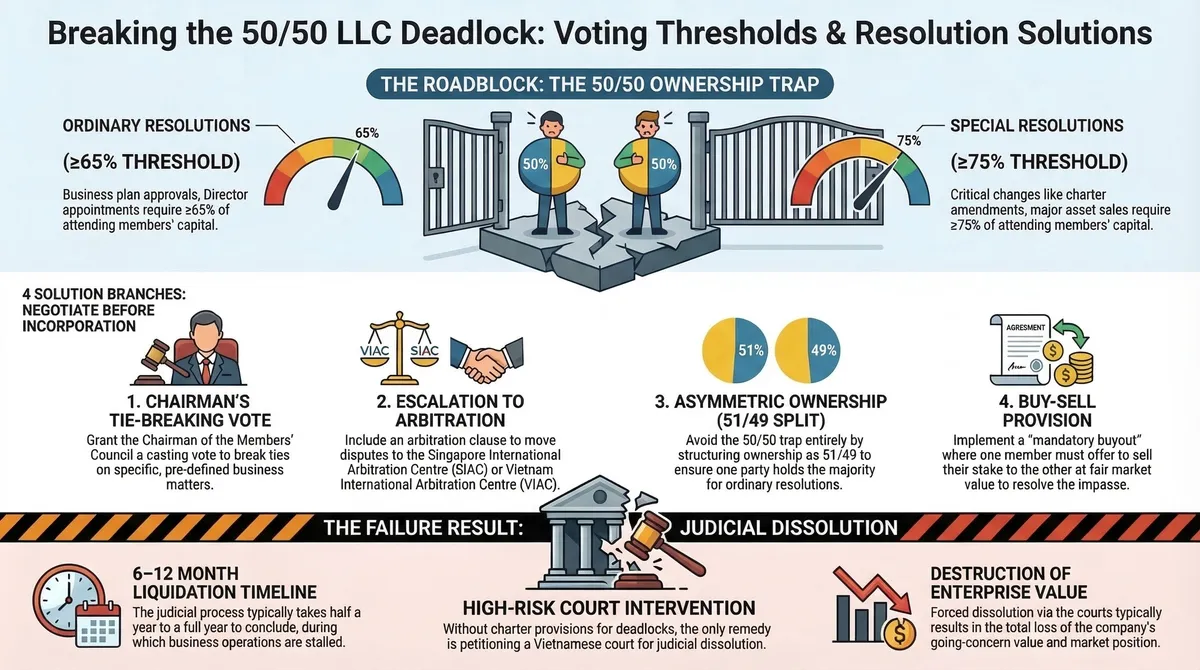
The 50/50 deadlock problem: Equal ownership creates gridlock when your charter requires supermajority approval. A 50% partner can block any major decision at both the 65% ordinary and 75% special resolution thresholds. Three solutions to negotiate before registration: Chairman casting vote on specific matters, arbitration clause through the Singapore International Arbitration Centre (SIAC) or Vietnam International Arbitration Centre (VIAC), or asymmetric ownership (51/49 instead of 50/50).
Vietnamese law doesn’t imply minority protections. Negotiate veto rights explicitly in your charter for borrowing limits, related-party transactions, and Director removal.
Meeting requirements: The Chairman provides ≥7 working days’ notice. Quorum requires members representing ≥65% of charter capital. Document every decision in signed minutes—tax audits request Council minutes to verify dividend distributions. If you can’t produce signed resolutions, the tax authority may reclassify distributions as salary subject to Personal Income Tax (PIT) at 5–35% instead of 0% withholding on dividends.
Members holding ≥25% of charter capital must be declared as beneficial owners under Decree 168/2025/ND-CP. This includes indirect ownership through holding companies. Maintain an internal register and update it within 15 days of ownership changes—from July 2025, synchronize with the National Enterprise Database via the National Business Registration Portal.
Director Authority and Dual Representative Structure
The Director must reside in Vietnam—valid visa, residence permit, and local address. For foreign-invested enterprises, this means either hiring a Vietnamese national or securing a work permit 15–20 days before the Enterprise Registration Certificate (ERC) application. The Director executes business plans, issues internal regulations, appoints employees, and signs contracts within authorized limits.
Personal liability is real: Tax authorities and labor inspectors hold the Director personally accountable. Three liability triggers under the Law on Enterprises:
- Duty of loyalty: Can’t compete with or use company assets without Council approval - Duty of care: Gross negligence causing company loss triggers personal liability - Unauthorized acts: Signing contracts beyond charter authority—the contract is voidable and the Director faces damages claims
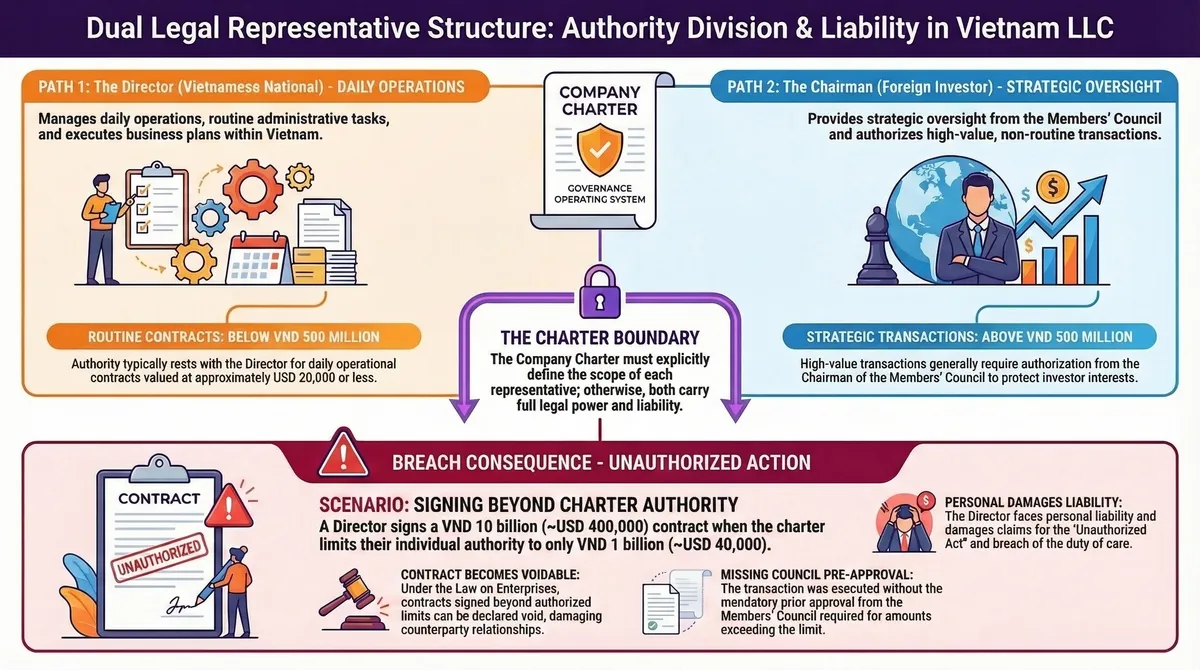
Dual representative structure Foreign-invested LLCs frequently appoint two legal representatives: a Vietnamese national as Director (daily operations, routine contracts) and a foreign investor representative as Chairman of the Members’ Council (strategic oversight, high-value transactions). A common split assigns Director signing power for contracts below VND 500 million (~USD 20,000), with the Chairman authorizing above that threshold.
The charter must explicitly define each representative’s scope. Without clear boundaries, both carry full authority—and full liability—under Article 12 of the Law on Enterprises 2020.
The Chief Accountant (Kế toán trưởng) is a separate statutory role from the Director—this position oversees accounting operations and co-signs statutory financial statements and tax filings under Circular 99/2025/TT-BTC (effective from FY2026, replacing Circular 200/2014/TT-BTC) and the Law on Accounting 88/2015/QH13. Both LLCs and JSCs must appoint a qualified chief accountant or engage a licensed chief accountant service before their first tax filing. Furthermore, all foreign-invested LLCs must undergo an annual statutory audit by an independent audit firm licensed in Vietnam under the Independent Audit Law 67/2011/QH12 within 90 days of the fiscal year-end.
Single-Member vs. Multi-Member: Which Structure Fits
Single-member LLC gives the sole owner full control. Board resolutions from headquarters authorize Vietnam subsidiary actions within days. No Members’ Council, no voting thresholds, no coordination overhead. Best for wholly-owned subsidiaries where the parent wants direct authority over IP, supply chain, and financials. The trade-off: no internal check on decision quality.
Multi-member LLC requires a Members’ Council with proportionate voting. Every major decision needs a formal meeting, quorum, and documented resolution. Best for joint ventures where Vietnamese partners provide market access, government relationships, or sector expertise. Your charter should allow virtual meetings and electronic voting to reduce coordination burden.
Conditional business lines (securities, logistics, education, healthcare) may mandate multi-member structure. Foreign ownership caps in certain industries require Vietnamese partners, forcing multi-member LLC governance regardless of your preference.
Charter Design: What to Lock In Before Registration
The LLC charter is the governance operating system. Every provision missed before filing becomes a 75% supermajority vote to fix later—if partners agree at all. Key provisions to negotiate:
Voting thresholds: Default is 65%/75%. You can set higher thresholds for specific decisions (borrowing above VND 10 billion (~USD 400,000), related-party transactions, Director removal) to protect minority positions.
Director authority limits: Define specific VND thresholds for contract signing authority. Annual review of these limits prevents either over-restriction (Director can’t operate) or under-restriction (Director commits beyond capacity).
Deadlock resolution: For multi-member LLCs, specify the mechanism—Chairman casting vote, escalation to arbitration (SIAC/VIAC), or buy-sell provision. Without a deadlock clause, a 50/50 JV can’t execute major transactions when partners disagree.
Member exit rights: Specify voluntary withdrawal procedures (typically 90-day notice), valuation method (book value, fair market value, or agreed formula), and Council approval threshold (≥65% for withdrawal affecting capital structure).
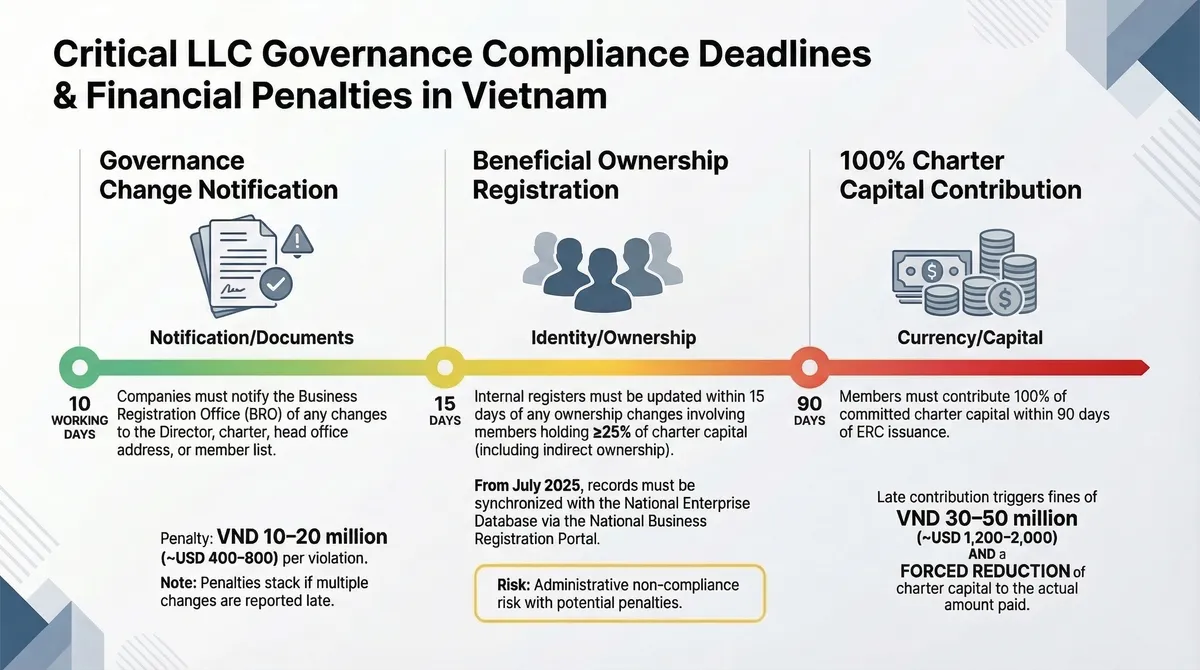
90-day capital contribution deadline: Members must contribute 100% of committed charter capital within 90 days from ERC issuance under Article 47 of the Law on Enterprises 2020. All contributions must flow through the company’s Direct Investment Capital Account (DICA) at an SBV-licensed bank.
Late contribution triggers fines of VND 30–50 million (~USD 1,200–2,000) per Decree 122/2021/ND-CP, Article 46. Authorities may also force charter capital reduction to actual paid amounts. If reduced capital falls below sector minimums for conditional business lines, the company risks business license revocation.
For the step-by-step registration process including document preparation and Department of Finance (formerly DPI) submission timelines, see the foreign company registration guide with IRC and ERC requirements.
10-day change notification rule: Any governance change—Director replacement, charter amendment, address change, member list update—requires Business Registration Office (BRO) notification within 10 working days. Late notifications incur VND 10–20 million (~USD 400–800) per violation under Decree 122/2021/ND-CP. Penalties stack: change Director and address late in the same period, and you face VND 20–40 million (~USD 800–1,600) total.
The Governance Failures That Cost Foreign Investors the Most
Director signs beyond authority. Your Director signs a VND 10 billion (~USD 400,000) contract when the charter limits signing authority to VND 1 billion (~USD 40,000). No Council pre-approval obtained. The contract is voidable, your Director faces personal damages claims, and the counterparty relationship is damaged. Fix: define clear VND thresholds in your charter, review limits annually, require Council pre-approval for above-threshold transactions.
Missing Council minutes at tax audit. Your LLC distributes VND 500 million (~USD 20,000) in dividends. Tax audit requests the Council resolution authorizing the distribution. No signed minutes exist. Result: dividends reclassified as salary—Personal Income Tax at 5–35% applies instead of 0% withholding, and the company loses the Corporate Income Tax (CIT) deduction. Fix: hold a formal Council meeting before every dividend distribution. Document in signed minutes. Archive for 10 years per accounting regulations.
Governance Decisions That Extend Beyond Your Charter
Nominee Legal Representative and Foreign Director Planning
Most foreign owners aren’t Vietnam-resident—which means they can’t serve as legal representative on the ERC without a valid work permit and Temporary Residence Card (TRC). The work permit alone isn’t enough: TRC must be active for the “residency” requirement to hold, and TRC validity depends on work permit validity. If either expires, your Director’s legal standing lapses.
The practical solution: appoint a Vietnamese nominee as legal representative for residency compliance. But the charter must tightly define the nominee’s authority scope. Without explicit limits, the nominee holds full legal power to sign contracts, authorize transactions, and represent the company to authorities.
The WP/TRC dependency creates an ongoing governance risk. If your foreign Director’s work permit expires, they no longer legally qualify as representative—blocking all Business Registration Office (BRO) filings until the situation is resolved. Plan renewal timelines into your governance calendar.
For appointed resident representative options, authority limitation frameworks, and WP/TRC planning, see foreign legal representative liability risks and the dual representative strategy and outsourced chief accountant services for FDI companies.
Corporate e-ID: Who Controls Governance Amendments
From July 2025, every governance change filed through BRO—Director replacement, charter amendment, capital modification—requires VNeID electronic authentication under Decree 69/2024/ND-CP. The Director’s VNeID access effectively controls the company’s ability to execute governance changes. If the Director leaves and VNeID transition hasn’t been planned, the company is locked out of enterprise registration amendments until a new representative completes personal verification.
For the registration process and foreign representative verification requirements, see the Vietnam corporate e-ID registration guide for FDI companies.
Members’ Council (LLC) vs. Board of Management (JSC)
If the multi-member LLC governance feels heavy—65/75% voting thresholds, formal meetings, documented resolutions for every major decision—compare Members’ Council mechanics to the JSC Board of Management before committing. Different structures carry different trade-offs. JSCs enable free share transfers for investor exits but add Supervisory Board requirements once you exceed 11 shareholders, with annual governance costs reaching VND 180–300 million (~USD 7,200–12,000).
For a side-by-side comparison of all entity structures, see LLC vs. JSC vs. RO vs. Branch: entity type comparison for foreign investors.
Structuring Your LLC Governance
The Members’ Council controls strategic decisions. The Director runs daily operations. The charter defines the boundary between them. Negotiate that boundary before registration—not after.
Three deadlines that trigger penalties: 90 days for full capital contribution (VND 30–50 million fine + forced reduction), 10 working days for governance change notifications to BRO (VND 10–20 million (~USD 400–800) per violation), and 15 days for beneficial ownership register updates for members holding ≥25% charter capital.
A VND 20 million (~USD 800) fine is a nuisance. Losing your business license because reduced charter capital falls below sector minimums is a market entry failure.
Need governance structure consultation? Indochina Link Vietnam provides charter drafting and LLC registration services, Members’ Council design, and Director appointment strategies for foreign-invested LLCs across all Vietnamese provinces.
LEGAL DISCLAIMER
This article provides general information on Vietnam LLC governance requirements based on Law on Enterprises 2020 and related regulations. It does not constitute legal advice. Foreign investors should consult qualified Vietnamese legal counsel for entity-specific compliance planning. Vietnamese regulations change frequently—verify current requirements with professional advisors before making governance decisions.