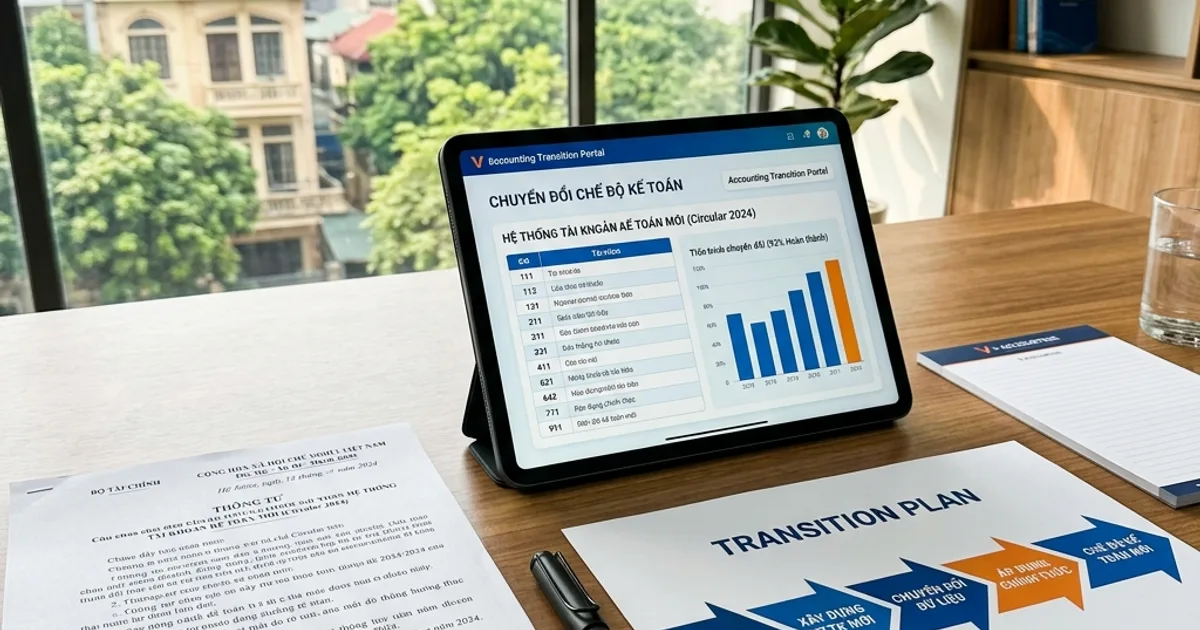






Vietnam GAAP is Vietnam’s three-tier statutory framework combining the Law on Accounting 88/2015/QH13 (amended by Law 56/2024/QH15), 26 Vietnamese Accounting Standards (VAS), and Ministry of Finance (MOF) regimes led by Circular 99/2025/TT-BTC from 1 January 2026. FDI enterprises apply Circular 99/2025 (unless eligible SMEs retain Circular 133/2016/TT-BTC) and file audited VAS statements in VND within 90 days of year-end.
Vietnam accounting compliance framework sets audit and filing duties alongside these differences, while IFRS (voluntary for International Financial Centre members from 1 January 2027 under Circular 118/2026/TT-BTC) and U.S. GAAP serve group reporting. This guide maps Vietnam GAAP’s tiers, compares VAS, IFRS, and U.S. GAAP conceptually, and resolves four core pairs (IFRS 15 vs VAS 14, IFRS 10 vs VAS 25, IAS 1 and IFRS 18 vs VAS 21, IFRS 16 vs VAS 06).
What Vietnam GAAP means under Law 88/2015, VAS, and Circular 99/2025
Vietnam GAAP (gaap vn) is a binding legal hierarchy rather than an interpretive handbook. The MOF issues VAS and IFRS guidance under Article 7.3 of the Law on Accounting 88/2015/QH13 (41/VBHN-VPQH; amended by Law 56/2024/QH15 from 1 January 2025).
Twenty-six VAS form the second tier. Issued from 2001 to 2005 via Decisions 149/2001/QD-BTC, 165/2002/QD-BTC, 234/2003/QD-BTC, 12/2005/QD-BTC, and 100/2005/QD-BTC, they omit numbers 09, 12, 13, and 20. All 26 VAS remain active in 2026.
Circular 99/2025 transition rules govern enterprises from 1 January 2026, replacing Circular 200/2014/TT-BTC (kept for state-owned enterprise equitization). Default level-1 accounts drop from 76 to 71, and firms may customize accounts via an internal policy manual (Quy chế hạch toán kế toán) under Article 11.2 of Circular 99/2025. Historical cost stays intact, excluding IFRS 15 and IFRS 16.
| Regime | Coverage | Key 2026–2027 rule | Basis |
|---|---|---|---|
| Circular 99/2025 | General enterprises & FDI | Effective FY2026; 71 accounts; manual governs COA edits | Circular 99/2025, Article 31.1 |
| Circular 133/2016/TT-BTC | Small & medium firms | Active in 2026; SMEs may elect Circular 99/2025 (>= 1 year) | Circular 133/2016; Circular 99/2025, Article 31.3 |
| Circular 202/2014 & 43/2026 | VAS consolidating parents | Circular 43/2026 adds Goodwill (279) & NCI (429); 10-year cap stays | Circular 202/2014/TT-BTC; Circular 43/2026/TT-BTC |
| Circular 118/2026 | IFC members only | Voluntary IFRS from 1 January 2027 after 30-day notice | Circular 118/2026, Article 2 |
Audited VND statements are due within 90 days of year-end under Circular 99/2025 (Articles 25 and 26.2), following mandatory annual audit under Law 67/2011/QH12.
FY2026 IFRS Myth: No General FDI Mandate Exists
IFRS is not mandatory in FY2026 for FDI firms, listed companies, or state-owned enterprises. Circular 118/2026/TT-BTC permits voluntary IFRS solely for International Financial Centre members from 1 January 2027 after 30 days' written MOF notice, under Article 5.4. Decision 345/QD-BTC (16 March 2020: 2020–2021 preparation, 2022–2025 voluntary phase, and a post-2025 mandatory phase pending MOF scope and timing) plus MOF's 5 November 2026 readiness survey confirm ordinary FDI enterprises remain on VAS.
Vietnam GAAP vs IFRS vs U.S. GAAP at a conceptual level
Vietnam GAAP prioritizes historical-cost measurement and statutory reporting templates, whereas IFRS (IASB) uses principles-based fair-value options and U.S. GAAP (FASB ASC) relies on rules-based guidance. Modern standards (IFRS 9, IFRS 13, IAS 36, IFRS 1) lack VAS counterparts.
Both Vietnam GAAP and U.S. GAAP block voluntary upward fixed-asset revaluation. Yet U.S. GAAP diverges sharply from VAS and IFRS on LIFO inventory, R&D expensing, and impairment reversals.
| Dimension | Vietnam GAAP (VAS + Circular 99) | IFRS | U.S. GAAP (ASC) | Basis |
|---|---|---|---|---|
| Hierarchy | Rules-based historical cost; 26 VAS | Principles-based; fair-value options | Rules-based FASB ASC; cost focus | Law 88/2015; IASB; FASB |
| Inventory | Five methods (no LIFO); reversals via 2294 | Prohibits LIFO; reversals required | Permits LIFO; reversals barred | Circular 99 (155, 156, 2294); IAS 2.25, 2.33; ASC 330-10-35-14 |
| Fixed assets | Cost only; VND 30 million threshold | Cost or revaluation; reversals required | Cost only; reversals barred | VAS 03, para. 28; Circulars 45/2013 & 30/2025; IAS 16.29, 36.114; ASC 360-10-35-20 |
| Intangibles | Development capitalized (7 criteria); land in 213/lease | Development capitalized (6 criteria) | R&D expensed (save software) | VAS 04, paras. 38, 40; VAS 03, para. 15; IAS 38.54, 38.57; ASC 730-10-25-1 |
| Statements | Four statements (B 01 - DN to B 09 - DN); zero OCI | Five components with OCI and equity | Statements with OCI; SEC Rule 5-02 | VAS 21; Circular 99; IAS 1; ASC 205, 220, 505 |
Three measurement asymmetries drive key multi-GAAP adjustments:
- Fixed assets vs impairment: VAS 03 (paragraph 28) matches ASC 360 by barring voluntary upward revaluation, unlike IAS 16.29. Vietnam GAAP lacks an IAS 36 PPE impairment rule (Account 229 excludes PPE), contrasting with IAS 36.114 reversals and ASC 360-10-35-20’s ban on reversing write-downs.
- LIFO exclusion: Although 2001 VAS 02 listed LIFO, Circular 99/2025 (Accounts 155, 156) limits inventory to five costing methods without LIFO and records write-downs and reversals in Account 2294 (Account 632). By contrast, U.S. GAAP ASC 330 permits LIFO and ASC 330-10-35-14 bars reversing prior inventory write-downs.
- R&D and land tenure: VAS 04 (paragraph 40) capitalizes development across seven criteria, closer to IAS 38.57 than ASC 730-10-25-1 expensing. Land use rights sit in Account 213 or prepaid/lease accounts (VAS 03, paragraph 15).
Four core standard pairs compared across VAS, IFRS, and U.S. GAAP
Four standard pairs create recurring cross-border reporting differences in Vietnam because VAS standard numbers differ from IFRS and U.S. GAAP (FASB ASC) codes.
| Topic | Vietnam GAAP | IFRS | U.S. GAAP | Query mix-up clarified |
|---|---|---|---|---|
| Revenue | VAS 14 & 15; Account 511 | IFRS 15 | ASC 606 | IFRS 15 vs VAS 14 (VAS 15 = construction) |
| Consolidation | VAS 25; Circulars 202 & 43 | IFRS 10 | ASC 810 & 350 | VAS 23 covers post-balance-sheet events |
| Presentation | VAS 21; Circular 99/2025 | IAS 1 (IFRS 18 2027) | ASC 205, 220, 505 | IFRS 1 covers First-time Adoption |
| Leases | VAS 06; Account 212 | IFRS 16 | ASC 842 | VAS 03 covers Tangible Fixed Assets |
Revenue recognition: IFRS 15 vs VAS 14 vs ASC 606
Goods revenue recognition depends on five risks-and-rewards tests under VAS 14 (Decision 149/2001/QD-BTC, paragraph 10) and Circular 99/2025 (Account 511), paired with VAS 15 for construction. Bundled sales allocate consideration by fair value across present and future items under Circular 99/2025, without five-step control rules.
IFRS 15 (effective 1 January 2018) and U.S. GAAP ASC 606 use the five-step model yet split on five rules.
- Collectibility: IFRS 15.9 sets probable at >50% (more likely than not), while ASC 606 uses likely to occur (~75%–80% in U.S. interpretive practice, without a statutory percentage).
- IP and shipping: For IP licensing, IFRS 15 classifies licenses as right-to-use or right-to-access, while ASC 606 divides IP into functional and symbolic categories. ASC 606-10-25-18B permits treating post-control shipping as fulfillment.
- Cost reversals and electives: IFRS 15.104 mandates reversing contract-cost impairments, whereas ASC 340-40-35-6 bars reversals. ASC 606 also allows excluding sales taxes and valuing non-cash consideration at inception.
Consolidated financial statements: IFRS 10 vs VAS 25 vs ASC 810
Statutory consolidation turns on >50% voting power or policy control under VAS 25 (Decision 234/2003/QD-BTC, effective 16 February 2004), reflecting IAS 27 (2003) rather than IFRS 10. Goodwill amortizes straight-line over at most 10 years (or higher impairment loss), under Article 20.1 of Circular 202/2014/TT-BTC, while FY2026 forms add Goodwill (Code 279) and NCI (Code 429) under Circular 43/2026/TT-BTC.
IFRS 10 (effective 1 January 2013) applies a single control test (power, returns, linkage) with annual IAS 36 impairment tests and zero amortization. U.S. GAAP ASC 810 checks Variable Interest Entities (VIEs, primary beneficiary by decision power and exposure) before Voting Interest Entities (>50% votes). ASC 350 bars goodwill amortization, save private-company ASU 2014-02 up to 10 years.
Searches for IFRS 10 vs VAS 23 miss the target: VAS 23 (Decision 12/2005/QD-BTC) covers Events After the Balance Sheet Date (IAS 10 / ASC 855).
Financial statement presentation: IAS 1 and IFRS 18 vs VAS 21 vs ASC 205
FDI subsidiaries prepare four statutory statements (B 01 - DN Statement of Financial Position, B 02 - DN income, B 03 - DN cash flow, and B 09 - DN notes) under VAS 21 and Article 17 of Circular 99/2025. Vietnam GAAP omits OCI and reports equity changes in B 09 - DN.
IAS 1 requires five components including OCI and an equity statement. IFRS 18 (effective 1 January 2027, replacing IAS 1) creates five income categories (Operating, Investing, Financing, taxes, discontinued operations), mandatory subtotals, and Management-defined Performance Measures (MPMs).
U.S. GAAP (ASC 205, ASC 220-10-45-1, ASC 505) sets no private COA (SEC Rule 5-02 covers public filers). ASU 2024-03 (DISE) applies to public business entities for annual periods beginning after 15 December 2026. Searches for IFRS 01 vs VAS 21 confuse presentation with IFRS 1 (effective 1 July 2009), governing First-time Adoption of IFRS (Circular 118/2026, Article 6.1).
Lease accounting: IFRS 16 vs VAS 06 vs ASC 842
Operating leases remain off a lessee’s balance sheet under VAS 06 (Decision 165/2002/QD-BTC, paragraph 19, effective 1 January 2003) and Circular 99/2025 (Account 212), which split finance and operating leases with no right-of-use (ROU) concept.
IFRS 16 (effective 1 January 2019) puts lessee leases on balance sheet (ROU depreciation, interest), exempting leases of 12 months or less and low-value assets (~USD 5,000 benchmark, no cap). U.S. GAAP ASC 842 capitalizes leases over 12 months yet keeps a dual P&L model (straight-line operating rent above EBITDA) without a low-value exemption.
Searches for IFRS 16 vs VAS 03 misroute to VAS 03 (Tangible Fixed Assets, Decision 149/2001/QD-BTC, matching IAS 16 / ASC 360) rather than VAS 06.
VAS-to-IFRS reconciliation bridge guidance details off-ledger adjustments, deferred taxes, and profit-repatriation rules between these pairs.
Statutory reporting boundaries for dual-GAAP FDI subsidiaries
Vietnamese statutory reporting boundaries apply regardless of your parent company’s IFRS or U.S. GAAP reporting. Your accounting records must use Vietnamese, and foreign text on financial statements must appear alongside Vietnamese, under Article 11.1 of the Law on Accounting.
Companies transacting primarily in foreign currency can keep books in that currency when meeting Circular 99/2025 (Articles 4 and 6), yet your filed, published, and audited statements still require VND. Maintaining two financial accounting ledger systems or issuing inconsistent statements for one period is prohibited under Article 13.10 of the Law on Accounting; see the dedicated guide on dual-view management accounts for dual-reporting boundaries.
Every FDI subsidiary completes an annual FDI statutory audit (Law 67/2011/QH12; Decree 17/2012/ND-CP) before the 90-day deadline. VAS bookkeeping and reporting services align statutory ledgers and parent mappings under one policy manual.
Frequently asked questions on Vietnam GAAP
What is Vietnam GAAP (gaap vn)?
Vietnam GAAP is Vietnam’s three-tier statutory framework combining the Law on Accounting 88/2015/QH13 (amended by Law 56/2024/QH15), 26 Vietnamese Accounting Standards (VAS), and Ministry of Finance regimes led by Circular 99/2025/TT-BTC from 1 January 2026.
Do FDI companies in Vietnam have to adopt IFRS in 2026 or 2027?
No. FDI enterprises follow Circular 99/2025/TT-BTC and VAS from 1 January 2026 (unless eligible SMEs keep Circular 133/2016/TT-BTC). Circular 118/2026/TT-BTC, effective 1 January 2027, permits voluntary IFRS strictly for International Financial Centre members.
How does U.S. GAAP differ most from Vietnam GAAP?
Both prohibit voluntary upward fixed-asset revaluation, yet U.S. GAAP requires ASC 606 five-step revenue control, ASC 842 on-balance-sheet leases, and ASC 810 VIE consolidation, and permits ASC 330 LIFO inventory, whereas Circular 99/2025 excludes LIFO and ROU capitalization.
Why do VAS 23, VAS 03, and IFRS 1 cause confusion in VAS-IFRS searches?
Standard numbers do not match across frameworks. VAS 25 covers consolidation (not VAS 23, which covers post-balance-sheet events), VAS 06 covers leases (not VAS 03, tangible fixed assets), and IAS 1 or IFRS 18 covers presentation (not IFRS 1).
ICLV’s IFRS Compliance team prepares statutory VAS statements and multi-GAAP group mappings for FDI subsidiaries in Vietnam. Schedule a Free Consultation.
Regulatory Notice: Information current as of November 2026 based on Vietnamese accounting regulations and referenced IFRS and U.S. GAAP standards in force; general guidance, not company-specific legal or tax advice.