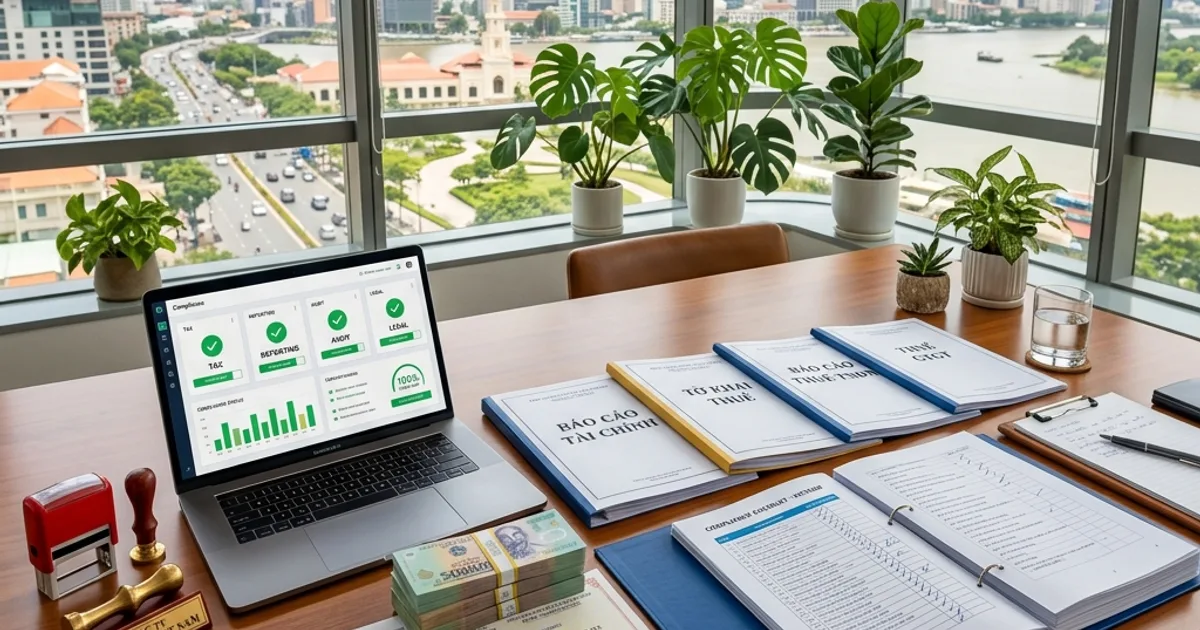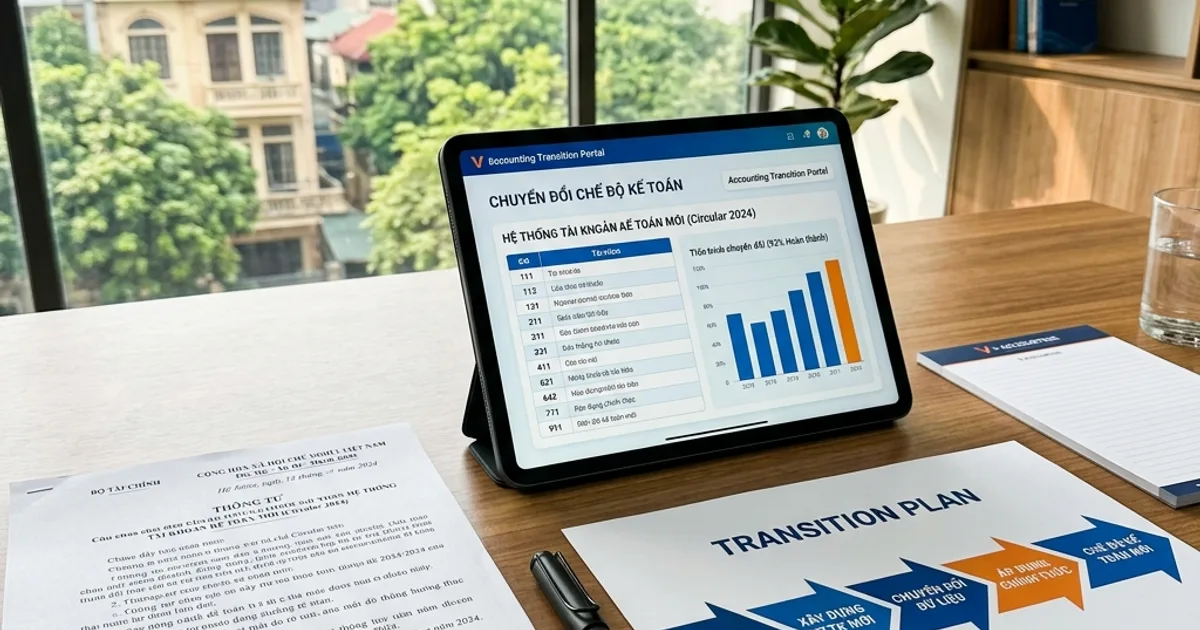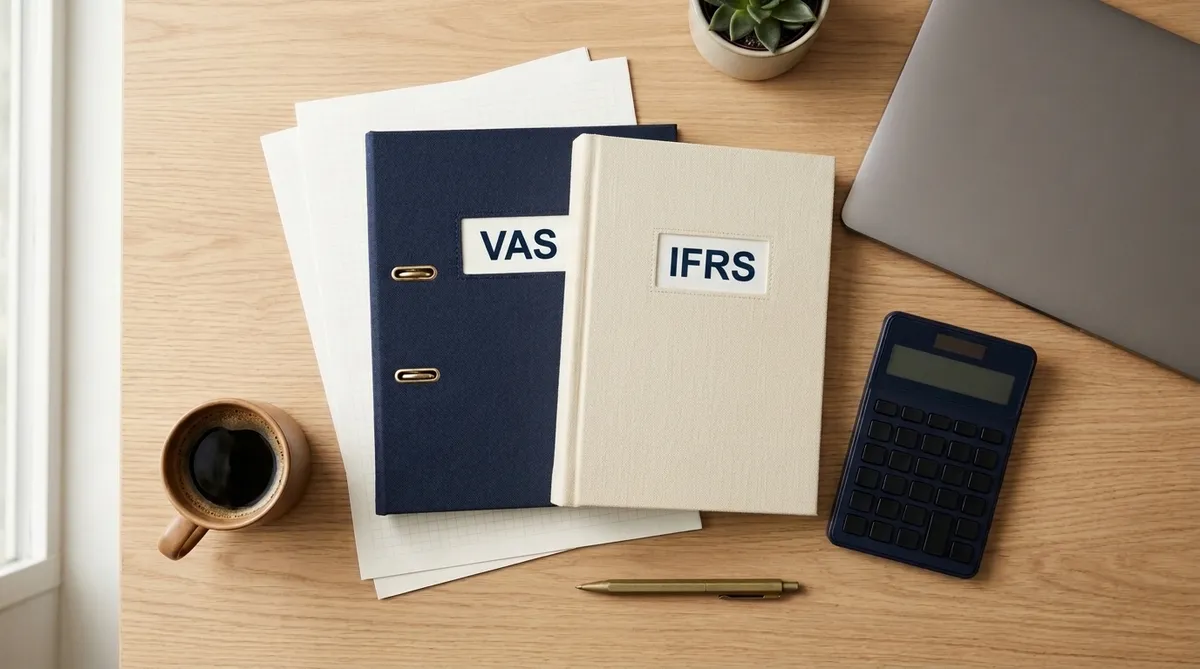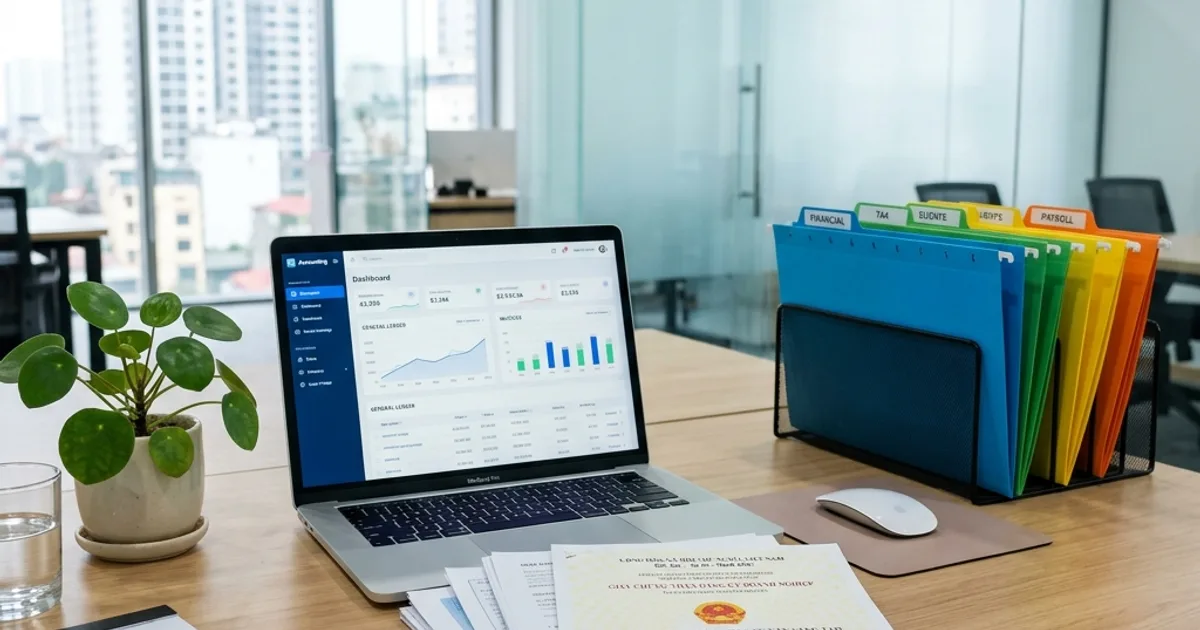






Vietnam sets no proprietary list of approved accounting software and requires no prior licence from the Ministry of Finance or the Tax Department. For companies under Circular 99/2025/TT-BTC, any chosen package is permitted if it meets statutory software standards and management and the Chief Accountant stand behind its figures. Circular 99/2025 applies to financial years starting on or after 1 January 2026, while qualifying SMEs may apply Circular 133/2016/TT-BTC. Since 1 July 2026, e-invoices under Decree 254/2026/ND-CP must be signed XML files, so the software choice determines whether statements (B 01-DN, B 02-DN, B 03-DN and B 09-DN) and e-invoices come out clean or need manual rework.
Vietnam accounting and reporting compliance sets the statutory baseline that any accounting system in an FDI company must reproduce. Three points shape the buying decision:
- No approved list: the law tests software output, not the brand.
- Two families: local VAS packages produce Circular 99 statements directly; global ERP needs a localisation layer.
- One ledger: a VAS ledger mapped to HQ reporting is lawful, a second financial ledger isn’t.
Accounting software in Vietnam has no approved list: what the law checks instead
Accounting software in Vietnam needs no licence or approval from the Ministry of Finance or the Tax Department. The law tests what the software produces. Pages that still cite Circular 200/2014/TT-BTC (superseded for corporate financial years starting 1 January 2026) or Decree 123/2020/ND-CP (superseded from 1 July 2026) describe rules replaced in 2026, so buyers should ask vendors for written Circular 99/2025 and Decree 254/2026 release notes.
Six standards any accounting software must meet under Circular 99/2025
Article 28 of Circular 99/2025 lets a company choose its own accounting software if the package meets six conditions:
- Lawful logic: follows accounting and tax law without changing accounting methods or recorded figures.
- Accurate processing: no duplicated data, and every correction leaves a time-ordered trace.
- Security: warns of or blocks deliberate changes to posted figures.
- Complete output: supplies full, timely data to authorities and other users.
- Connectivity: connects, or is ready to connect, to e-invoice and digital signature software.
- Upgradability: can be amended when the law changes.
The same article assigns responsibility for accurate and truthful figures to the company’s managers and its Chief Accountant, or person in charge of accounting. Circular 103/2005/TT-BTC, still in force, adds baseline conditions such as ledger reconciliation, user permissions and backup.
The Law on Accounting 88/2015/QH13 accepts electronic records. Electronic vouchers must stay unaltered in transmission, under Article 17. Electronic books need no cross-page seal, but after the year-end close they must be printed and bound, or archived securely and searchably for the full retention period, under Article 26.
Circular 99/2025 changes also reset the chart of accounts the software must hold, so a pre-2026 configuration needs a fresh review even with the same vendor.
E-invoice connection under Decree 254/2026/ND-CP and Circular 91/2026/TT-BTC
Decree 254/2026 and Circular 91/2026/TT-BTC have governed e-invoices since 1 July 2026. Under Article 3 of Circular 91/2026, an e-invoice is an XML file in two parts, business data and digital signature data, exchanged over the SOAP protocol. The seller’s digital signature and signing time are mandatory. The buyer’s signature is optional unless the parties agree otherwise.
For the accounting system, that means generating a valid XML file signed with the seller’s digital signature and supporting transmission through a qualified e-invoice service provider. Standard non-code invoices using the full-content format are sent no later than the next working day after issue, whereas cash-register e-invoices are sent by the end of the day (designated sectors follow summary-table rules).
E-invoice registration in Vietnam covers registration steps, invoice categories and error handling; this guide stays with what the software must output.
Why IFRS-only accounting software cannot keep statutory books
An IFRS-only package can’t keep the statutory books of an ordinary FDI company. Records are kept in Vietnamese, or bilingually in Vietnamese and a foreign language, and statements that are filed, published or audited are presented in VND, even where the books themselves run in a foreign currency. Circular 118/2026/TT-BTC, effective 1 January 2027, allows voluntary IFRS only for members of the International Financial Centre in Vietnam.
Accounting software options for FDI: local VAS packages vs global ERP
Accounting software for FDI companies in Vietnam falls into two groups: local packages built around VAS, and global ERP or cloud products that need a localisation layer to produce Circular 99 statements. The table compares eight products on vendor-documented capabilities only.
| Software | Group | Circular 99/2025 (vendor-stated) | E-invoice and tax XML | Language and currency | Gap for FDI statutory books |
|---|---|---|---|---|---|
| MISA AMIS / MISA SME | Local VAS | Supported | MISA meInvoice; HTKK XML export | English and bilingual docs (AMIS) | None documented |
| FAST (Fast Business Online) | Local VAS | Supported | Fast e-Invoice; HTKK XML export | Multi-currency; Vietnamese-English reports | None documented |
| BRAVO 8R3 ERP-VN | Local VAS / ERP | Updated (vendor-stated) | Several e-invoice providers; HTKK XML export | Multi-currency; Unicode VI, EN, JA, KO, ZH | None documented |
| FTS Accounting / FTS ERP | Local VAS / ERP | Supported | FTS E-Invoice; input-invoice XML import; HTKK link | Multi-currency; VI, EN, KO, ZH, JA; parallel group reports | None documented |
| SAP S/4HANA Cloud | Global ERP | Official Vietnam localisation (B 01-DN, B 02-DN, VAT) | E-invoice via SAP DRC or partner | Global product | Vendor docs list B 01-DN and B 02-DN; B 03-DN and B 09-DN not stated |
| SAP Business One | Global ERP | Generic e-invoice framework only | Partner add-on | Global product | VAS statements, HTKK XML, USB Token/HSM and T-VAN via partner add-on |
| Oracle NetSuite | Global ERP | No Circular 99 statements | VAT report source (01/GTGT) via International Tax Reports; native e-invoice excludes Vietnam | Global product | Partner SuiteApp for VAS statements, HTKK XML, signature and T-VAN |
| Xero | Global cloud | No Vietnam localisation | None stated | Global product | HQ management reporting only from the VAS ledger; no statutory VAS books |
Basis: official vendor documentation reviewed November 2026; capabilities change with each release.
Local VAS software: MISA, FAST, BRAVO and FTS
All four document Circular 99/2025 support and e-invoice connectivity, through a built-in service or, for BRAVO, several providers; MISA, FAST and BRAVO document HTKK XML export, while FTS documents an HTKK link. The differences sit in group features: BRAVO and FTS document multi-language interfaces and multi-currency ledgers, and FTS adds parallel group reports. Local accounts can be configured or mapped to match headquarters reporting lines where group consolidation is required.
Global ERP and cloud platforms: SAP, NetSuite and Xero in Vietnam
SAP S/4HANA Cloud documents an official Vietnam localisation for B 01-DN, B 02-DN and VAT, with e-invoices sent through SAP DRC or a partner. SAP Business One relies on partner add-ons for VAS statements, HTKK XML, USB Token or HSM digital signature and T-VAN workflows, while Oracle NetSuite relies on partner SuiteApps for VAS statements, HTKK XML, digital signature and T-VAN. Xero has no Vietnam localisation, so it serves only for group management reporting fed from a statutory VAS system or bookkeeping service rather than keeping Vietnam financial books.
What drives total cost beyond the licence
A fair comparison counts every cost component, not only the headline fee:
- licence or subscription;
- VAS localisation add-on or partner bundle (global ERP);
- e-invoice service and digital signature integration;
- implementation partner for chart of accounts mapping and report templates;
- in-house VAS accountant and Chief Accountant, or an outsourced service.
Accounting system design: one VAS ledger mapped to HQ reporting
An accounting system in Vietnam keeps one VAS ledger and maps it to the HQ chart of accounts. A second financial ledger is not a lawful alternative.
Chart of accounts mapping under Circular 99/2025
Article 11 of Circular 99/2025 lets a company amend account names, numbers, structure and content under an internal accounting policy, provided statutory statement line items stay the same. The default chart has 71 level-1 accounts, down from 76, feeding the Statement of Financial Position (B 01-DN), income statement (B 02-DN), cash flow statement (B 03-DN) and notes (B 09-DN).
Management accounts under VAS and IFRS covers the monthly bridge adjustments, such as revenue timing, leases and FX, that sit on top of this mapping.
Accounting setup for FDI companies walks through go-live steps, including regime choice and opening balances.
Controls the accounting system should enforce
Three controls belong inside the software, not in a spreadsheet:
- Non-cash payment flag: purchases of VND 5,000,000 or more (including VAT) need non-cash payment records for input VAT credit and CIT deduction (Decree 181/2025/ND-CP, Decree 320/2025/ND-CP), with same-day purchases from one seller added together.
- Supplier status check: an invoice dated from the day the tax authority determines a seller is not operating at its registered address (tax code status 06) is an unlawful invoice under Circular 90/2026/TT-BTC and Decree 254/2026, barring VAT credit and CIT deduction, so the system flags vendor tax-code status before booking input VAT.
- Correction trail: changes to posted entries go through a dated adjusting voucher, never an overwrite.
Accounting system risks: two sets of books, invalid e-invoices and missed audits
Keeping two sets of financial books breaches Vietnamese accounting law, while off-book items, invalid input invoices and skipped mandatory audits carry direct organisation-level fines. Article 13 of the Law on Accounting bans leaving assets or liabilities off the books, keeping two or more financial accounting ledger systems, and issuing statements with inconsistent figures for the same period.
Every FDI company must have its annual financial statements audited under Article 15 of Decree 17/2012/ND-CP. Circular 99/2025 requires those audited statements to be filed within 90 days of year-end, so the accounting system must deliver a closed, reconciled VAS ledger in time.
When accounting software needs outsourced bookkeeping or a Chief Accountant
Accounting software doesn’t replace the Chief Accountant that Vietnamese law requires, unless the law provides otherwise. A company appoints one or hires a Chief Accountant service under the Law on Accounting, and Article 20 of Decree 174/2016/ND-CP allows an acting person in charge of accounting for at most 12 months. Circular 101/2026/TT-BTC governs the Chief Accountant training certificate from 1 January 2027.
For subsidiaries without an in-house VAS accountant, those running a global ERP without Vietnam localisation, or groups requiring monthly English and Vietnamese reporting, bookkeeping and financial reporting services cover the VAS monthly ledger, parent-format chart of accounts mapping and bilingual management reports, starting from $200 / month.
Next steps for choosing accounting software in Vietnam
- Test the output, not the brand: one B 01-DN and one signed XML e-invoice from sample data.
- Choose a local VAS package, or a global ERP with a documented localisation add-on.
- Keep one VAS ledger mapped to HQ reporting, with a Chief Accountant behind it.
ICLV sets up the accounting system and report templates using software that suits the company’s size and its headquarters’ requirements. Schedule a Free Consultation.
Information current as of November 2026; general guidance, not company-specific advice.