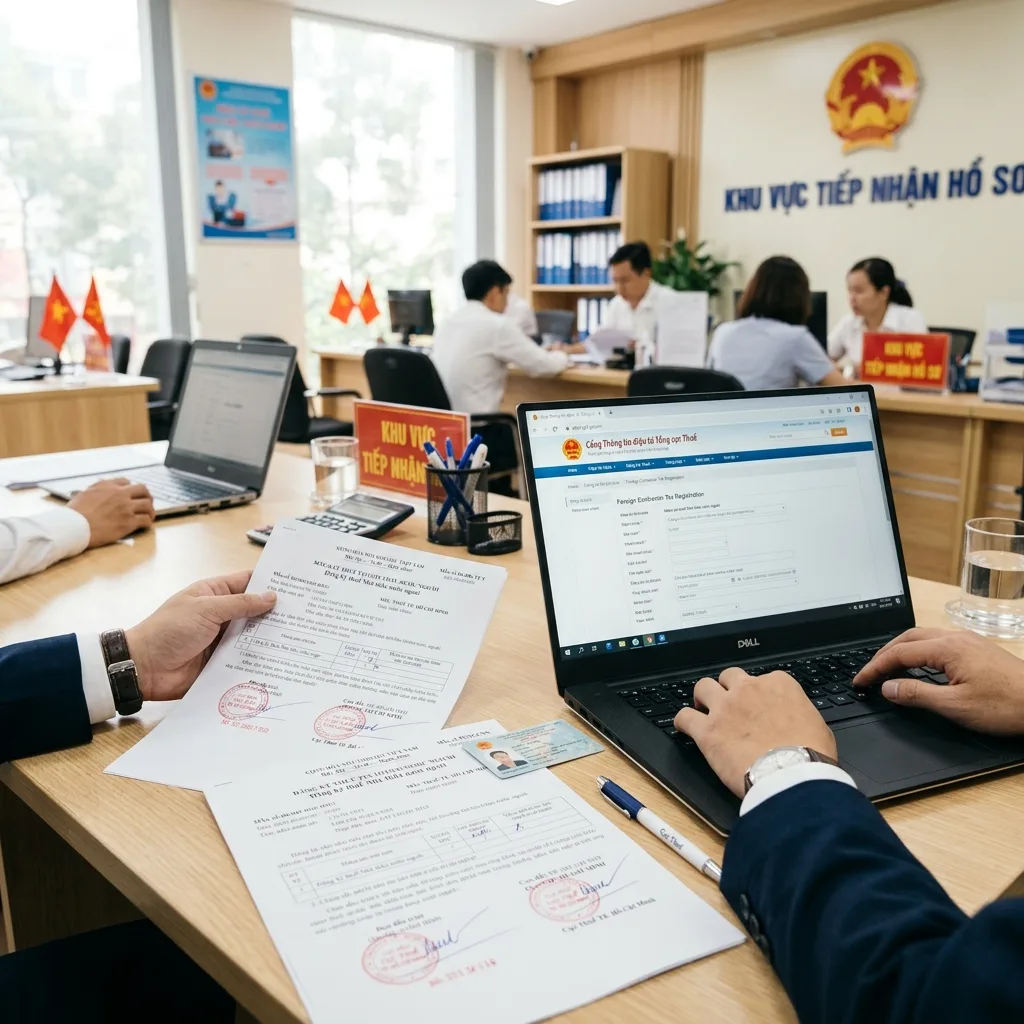








Investment project VAT refunds allow foreign-invested enterprises to recover input VAT accumulated during Vietnam’s pre-operational construction phase — before the project generates any revenue (Law 48/2024/QH15, Article 15.2.a, effective July 1, 2025). Eligibility requires VND 300 million (~USD 12,000) in accumulated input VAT, with refund applications submitted within 1 year of the project commencing operations. Missing the 1-year deadline forfeits refund rights permanently. First-time FDI applicants face rejection rates above 30%, primarily from documentation gaps and Form 02/Form 01 declaration errors.
Key takeaways
- Accumulated input VAT must reach VND 300 million (~USD 12,000) during the investment phase. Use the deduction method with separate VAT declarations (Form 02/GTGT).
- Submit refund applications within 1 year from the date your project starts generating revenue — not from construction start (Law 48/2024/QH15, Article 15.2.a).
- First-time rejection rate exceeds 30%. Top causes: mixed declarations, IRC scope mismatch, incomplete invoice chains.
- Supplier VAT compliance verification removed from January 1, 2026 (Decree 359/2025/ND-CP) — no longer a refund blocker.
Eligibility: VND 300 million threshold and 1-year deadline
Investment project VAT refund eligibility activates when accumulated input VAT reaches VND 300 million (~USD 12,000) after offsetting against any output VAT generated during construction. The project must use the deduction method and file separate VAT declarations from operational business activities.
⚠️ CRITICAL DEADLINE: Refund applications must be submitted within 1 year from the date the project commences revenue generation (Law 48/2024/QH15, Article 15.2.a). A project starting operations in June 2025 must file by June 2026 — regardless of when construction began. Missing the deadline forfeits refund rights permanently.
The VND 300 million calculation: sum all input VAT from investment-phase purchases (machinery, construction materials, consulting services), subtract any incidental output VAT generated during construction. The remaining undeducted amount must reach VND 300 million per tax period.
New vs expansion projects
The distinction between new and expansion projects determines refund processing path, CIT incentive eligibility, and documentation requirements — misclassification triggers automatic rejection.
New investment projects establish a distinct legal entity or production facility with a separate Investment Registration Certificate (IRC) issued by provincial authorities. Expansion projects modify existing registered capital or production capacity within the same legal entity. Expansion projects may inherit existing tax incentives if they maintain the same business sector and meet conditions including minimum 20% increase in fixed assets or production capacity.
In practice, expansion projects face higher scrutiny because tax authorities must verify that new purchases serve the expanded scope rather than the existing operational base. Projects adding a second production line within an existing factory frequently face requests for supplementary documentation proving the additionality of equipment purchases.
Form 02 (investment) vs Form 01 (operational)
The Form 02/Form 01 separation is the most common failure point for first-time FDI applicants. During the investment phase, VAT declarations must be filed on Form 02/GTGT — separate from operational business declarations on Form 01/GTGT. Mixing the two triggers automatic rejection.
The separation matters for refund calculation: only input VAT declared on Form 02 qualifies for investment project refund. Equipment purchased for an existing operational line but declared on Form 02 will be flagged during audit. Project accounting must be strictly segregated from operational accounting throughout the construction phase.
Conditional business lines
Projects in real estate development, mining, securities trading, or sectors requiring special licenses face additional scrutiny. Applicants must demonstrate full compliance with investment conditions before refund approval — a real estate project without completed land clearance or a mining project lacking environmental permits will face rejection regardless of documentation completeness.
| Criterion | Requirement | Verification document |
|---|---|---|
| Input VAT threshold | ≥ VND 300 million (~USD 12,000) | VAT declaration forms (Form 02) |
| Declaration method | Deduction method registered | Tax registration certificate |
| Separate filing | Investment VAT isolated from operations | Separate Form 02 submission |
| Investment status | Pre-operational phase | Investment Registration Certificate |
Phased construction: when does “completion” trigger the refund deadline?
Investment project refund deadlines for single-phase projects start when the project generates first revenue. Staged projects create ambiguity — does each phase trigger a separate deadline, or does entire project completion start the clock?
Current practice: tax authorities treat each independently operational phase as a separate trigger. If Phase 1 of a factory starts producing in March 2026 while Phase 2 is still under construction, the 1-year deadline applies to Phase 1’s input VAT from March 2026. Phase 2 receives its own deadline when it becomes operational.
The Form 02 → Form 01 transition marks the critical boundary. When a project phase starts generating revenue, the enterprise transitions the completed phase from Form 02 (investment) to Form 01 (operational). Any unclaimed input VAT on Form 02 at the transition point must be included in the refund application — or it rolls into Form 01 as carry-forward credit, which follows different (and less favorable) refund rules.
Filing the refund application before the Form transition is essential. Once input VAT moves to Form 01, it no longer qualifies under the investment project refund category.
Documentation and submission
Incomplete documentation causes 40% of investment project refund rejections. A complete dossier must be compiled before submission — incomplete applications restart the processing clock from zero.
Required documents:
- Form 01/HT (official VAT refund application)
- Certified copy of Investment Registration Certificate (IRC)
- Land Use Rights Certificate for project location
- Complete VAT invoice chain for all input purchases (with valid non-cash payments exceeding VND 20 million per transaction)
- Project approval documents from investment licensing authority
- Separate VAT declarations (Form 02) for the investment phase
| Document | Purpose | Common rejection reason |
|---|---|---|
| Form 01/HT | Official refund request | Calculation errors, missing signatures |
| IRC | Proves project legal status | Scope mismatch with purchases |
| VAT invoice chain | Verifies input VAT amounts | Incomplete chain, invalid invoices |
| Land Use Rights Certificate | Confirms project location | Name mismatch with IRC |
The most overlooked documentation requirement: non-cash payment proof. Under Decree 181/2025/ND-CP, input VAT is only deductible for purchases paid through bank transfer. Cash payments — even with valid VAT invoices — are excluded from the refund calculation. Construction contractors and equipment vendors paid partially in cash create gaps that auditors flag immediately.
Submit electronically through dichvucong.gdt.gov.vn with a valid digital signature certificate. Acknowledgment arrives within 2 working days. Incomplete applications receive rejection notices within 5 working days — corrected applications must be resubmitted within 30 days to maintain the original application date.
Supplier VAT compliance verification is no longer required for applications submitted from January 1, 2026 (Decree 359/2025/ND-CP). All supplier e-invoices must still be valid and properly issued — the change removes buyer liability for supplier non-compliance, not invoice verification itself. For the full VAT refund framework including export and 5% VAT categories, see VAT Refund for FDI.
Processing timeline and provincial differences
Statutory vs reality
The statutory processing timeline is 40 working days from complete dossier receipt under the “Audit First, Refund Later” procedure. Investment project refunds default to this audit-first approach due to pre-operational nature and higher scrutiny.
In practice, expect 60-90 days for first-time applicants. Tax authorities conduct field inspections for refund amounts exceeding VND 1 billion (~USD 40,000). Incomplete documentation restarts the clock — the 40-day period begins only after all supplementary documents are submitted. Provincial capacity matters: HCMC and Hanoi maintain dedicated investment project units averaging 50-60 days for high-risk cases, while industrial provinces like Bình Dương and Đồng Nai process within 40-50 days due to standardized FDI documentation flows.
Risk-based classification:
- Low-risk (rare): 6 working days — established FDI enterprises with multiple successful investment phases and clean compliance history
- Standard-risk: 15-20 working days — mid-sized projects from known investors
- High-risk (most common for investment projects): 40 working days — first-time investors, conditional business lines, or refunds exceeding VND 1 billion (~USD 40,000)
Timing strategy: when to file
If your project will generate more input VAT in upcoming months, consider waiting until the total reaches VND 500 million to 1 billion (~USD 20,000-40,000). This reduces administrative burden and multiple submission costs. However, if construction is complete and no further VAT will accumulate, submit immediately once VND 300 million is met to optimize cash flow recovery.
Risks and common rejection triggers
First-time investment project refund applications face rejection rates exceeding 30%. Understanding why prevents 3-6 month delays from resubmission cycles.
Documentation gaps (40% of rejections): Missing invoice chains, IRC scope mismatches with actual purchases, or Land Use Rights Certificate name discrepancies with the IRC holder. Tax authorities reject applications immediately when any core document is absent.
Declaration errors (25% of rejections): The most common mistake — mixing investment-phase VAT with operational business declarations. FDI enterprises must file two distinct declarations: Form 02 for investment, Form 01 for operations. Combining them triggers automatic rejection.
Conditional business lines (30%+ rejection rate): Real estate, mining, and securities projects undergo enhanced scrutiny. Full investment condition compliance must be demonstrated before approval. Processing times extend beyond the standard 40-day period.
Audit triggers: Refund amounts exceeding VND 1 billion (~USD 40,000) require mandatory field inspections. Cross-province projects where suppliers are located in different provinces than the project site trigger additional documentation requests.
| Common mistake | Consequence | Prevention |
|---|---|---|
| Mixed Form 01/Form 02 declarations | Immediate rejection, 3-month delay | Segregate investment VAT strictly |
| Incomplete invoice chain | Supplementary request, 60-day restart | Verify all invoices before submission |
| IRC scope mismatch | Rejection + potential audit trigger | Ensure purchases align with registered activities |
| Premature submission | Below VND 300M threshold rejection | Calculate accumulated VAT accurately before filing |
For transfer pricing documentation requirements where related parties are involved in project financing, ensure your intercompany arrangements are properly documented before filing. CIT incentive eligibility should also be modeled alongside VAT refund timing to optimize your total tax position during the investment phase. For VAT registration and rate structure details, see the VAT Guide for FDI. For the complete Vietnam tax framework, see our Tax System hub →.