



Executive Key Takeaways
- Effective Date: Circular 99/2025/TT-BTC takes effect 1 January 2026, applicable to financial years commencing on or after this date.
- IFRS Convergence Focus: The reform accelerates Vietnam’s alignment with International Financial Reporting Standards (IFRS), emphasizing transparency and quality of financial reporting.
- Mandatory Consolidation: Enterprise Financial Statements must integrate financial information of the head office and all affiliated units, with elimination of all internal transactions. The previous “Total Financial Statements” concept is abolished.
- COA Autonomy: Enterprises may independently amend or supplement Chart of Accounts (from Level 2 onwards) without Ministry of Finance approval, provided they issue an Accounting Policy Regulation.
- New Biological Assets Account: Circular 99 introduces Account 215 – Biological Assets as a dedicated Level 1 account, separating these assets from Tangible Fixed Assets.
- Non-Going-Concern Reporting: Enterprises facing dissolution, bankruptcy, or cessation within 12 months must prepare financial statements using the DNKLT template set with specific revaluation requirements.
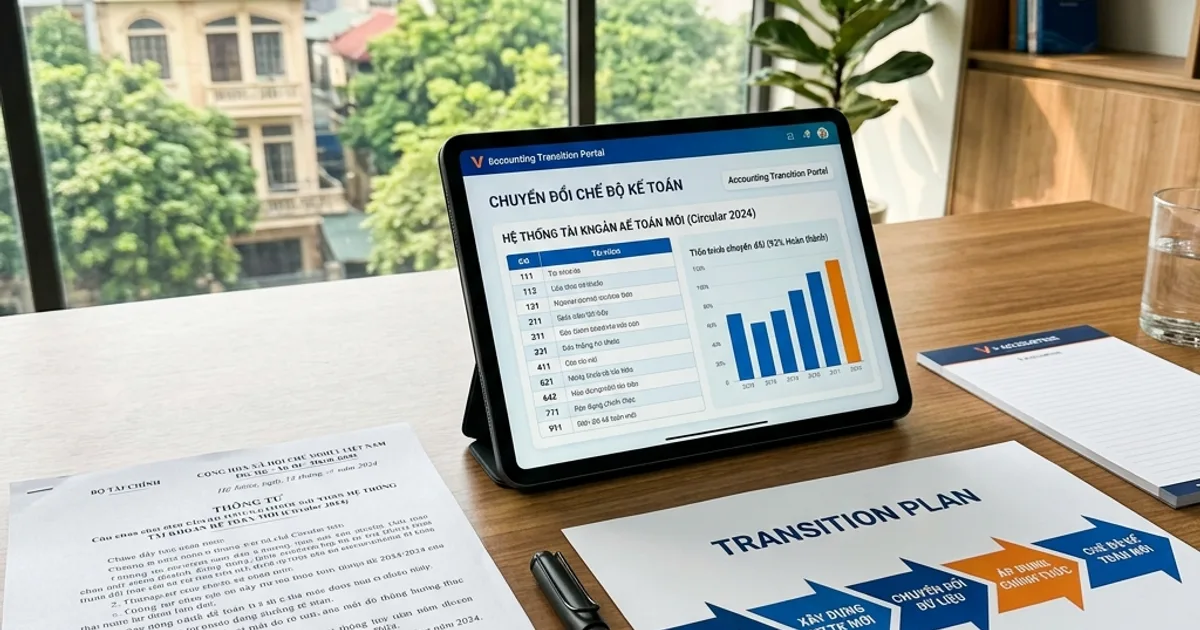
The Ministry of Finance issued Circular 99/2025/TT-BTC on 27 October 2025, effective 1 January 2026. This circular replaces Circular 200/2014/TT-BTC and accelerates Vietnam’s convergence with International Financial Reporting Standards (IFRS). The reform focuses on three pillars: operational flexibility, transparency, and internal governance quality.
Enterprises operating in Vietnam, including foreign-invested companies, must strategically adapt their systems and meticulous compliance protocols to manage the following core structural and operational amendments. Indochina Link Vietnam assists clients with this transition.
1. Terminology and Organisational Scope
Circular 99 standardizes nomenclature and significantly expands regulatory expectations concerning corporate structure and internal control obligations.
| Aspect | Circular 200/2014/TT-BTC | Circular 99/2025/TT-BTC | Impact Level |
|---|---|---|---|
| Financial Statement Name | Used the name “Bảng cân đối kế toán” (Balance Sheet). | Renamed to the authoritative title “Báo cáo tình hình tài chính” (Statement of Financial Position). | Low |
| Applicable Scope | Applied generally to enterprises across all sectors and economic components. | Expanded application, now explicitly including credit organizations and foreign bank branches (excluding specific banking operations). | Medium |
| Affiliated Units Terminology | Used the terminology “đơn vị hạch toán phụ thuộc” (dependent accounting unit). | Standardized terminology to “đơn vị trực thuộc” (affiliated unit). | Low |
| Reporting Principle for Units | Permitted enterprises to determine the level of accounting decentralization. | Mandates Consolidation and Internal Elimination: Enterprise Financial Statements must integrate financial information of the head office and all affiliated units and eliminate all internal transactions. The previous “Total Financial Statements” concept is abolished. | High |
| Corporate Governance and Control | Did not mandate robust internal management requirements. | Mandatory requirement for effective internal governance regulations and internal control systems, clearly delineating rights, obligations, and responsibilities. | High |
Internal transactions requiring elimination include: (1) inter-unit sales of goods/services, (2) inter-unit loans and interest, (3) inter-unit asset transfers (e.g., head office selling equipment to branch), (4) management fee allocations between units. Failure to eliminate overstates both revenue and expenses.
Terminology and Organisational Scope In Practice
Scenario 1 - Manufacturing FDI with Multiple Branches: A foreign-invested manufacturing company operates a head office in Hanoi and three production branches in Hai Phong, Da Nang, and Ho Chi Minh City. Under Circular 99, the company must eliminate all inter-branch inventory transfers in consolidated statements. For example, if the Hanoi head office transfers raw materials worth VND 500 million to the Hai Phong branch, this internal transaction must be eliminated to avoid overstating both revenue (at head office) and cost of goods sold (at branch).
Scenario 2 - Service Company with Regional Offices: A consulting firm with a head office and two regional offices must eliminate management fee allocations between units. If the head office charges VND 200 million in management fees to regional offices, these internal charges must be eliminated in the consolidated financial statements. Understanding chief accountant responsibilities in vietnam is essential for implementing these consolidation requirements effectively.
Key Risk: ⚠️ Failing to eliminate internal sales between head office and branches will overstate revenue and trigger tax audit flags. Tax authorities can assess additional corporate income tax on the overstated revenue, plus penalties for inaccurate reporting. Enterprises must implement robust inter-unit transaction tracking systems before 1 January 2026.
2. Regulations on Currency Unit and Exchange Rate
The new Circular 99 establishes highly specified standards for foreign currency accounting, promoting reliable measurement (per VAS 10 - Effects of Changes in Foreign Exchange Rates).
| Aspect | Circular 200/2014/TT-BTC | Circular 99/2025/TT-BTC | Impact Level |
|---|---|---|---|
| Functional Currency Selection | Permitted foreign currency selection if specific conditions are met. | Clarifies Criteria: Foreign currency can be selected only if it primarily influences sales prices, labour costs, raw material costs and is used for primary receipts/payments. | High |
| Change in Functional Currency | Allowed when significant operational changes occurred. | Highly Restricted: Change is prohibited unless a material shift in operations occurs, and it must only be effected at the commencement of a new accounting year. | High |
| Conversion Rate upon Change | Did not clearly specify the methodology for converting asset and capital balances. | Specified Methodology: Balances convert using the average transfer exchange rate (mean of buying/selling rates) of the frequently transacted commercial bank on the date of change. | Medium |
| Year-End Revaluation Rate | Typically used the commercial bank’s foreign currency buying rate for monetary items. | Requires the average transfer exchange rate of the commercial bank regularly used by the entity. | Medium |
Clarification on “Primarily Influences” Threshold: Circular 99 does not specify a numerical threshold for “primarily influences.” In practice, tax authorities expect foreign currency to represent at least 70% of sales revenue or operating costs. Document your calculation methodology in the Accounting Policy Regulation.
Currency Unit and Exchange Rate In Practice
Scenario 1 - Export-Oriented Manufacturer: A foreign-invested electronics manufacturer exports 85% of production to the EU and USA, receiving payments in EUR and USD. Raw materials (70% of costs) are imported and paid in USD. Under Circular 99’s clarified criteria, this enterprise qualifies to use USD as functional currency, as it primarily influences both sales prices and raw material costs.
Scenario 2 - Functional Currency Change: A garment exporter previously used VND as functional currency but shifted 80% of sales from domestic market to EU export markets in 2025. The company can change functional currency to EUR effective 1 January 2026, converting all asset and capital balances using the average transfer exchange rate of their primary commercial bank (e.g., Vietcombank) on 1 January 2026. This transition is part of broader [Vietnam tax law updates](/Vietnam new VAT law 2025: Key changes and compliance) affecting foreign enterprises.
Key Risk: ⚠️ Changing functional currency mid-year is prohibited under Circular 99. If your export markets shift significantly during 2026, you must wait until 1 January 2027 to effect the functional currency change. Premature changes will be rejected during tax audits, requiring restatement of financial statements and potential penalties.
3. Accounting System, Vouchers, and Chart of Accounts (COA)
Circular 99 implements a principle of responsible autonomy, granting enterprises the ability to customize their accounting programs internally, provided they document their decisions meticulously.
| Aspect | Circular 200/2014/TT-BTC | Circular 99/2025/TT-BTC | Impact Level |
|---|---|---|---|
| COA Modification | Required written approval from the Ministry of Finance for changes to Level 1 or Level 2 accounts. | Independent Amendment: Enterprises may independently amend or supplement titles, codes, structure, and content (from Level 2 onwards) without seeking authorisation. | High |
| Internal Documentation | Lacked specific mandatory internal regulation requirements upon change. | Mandatory Policy Regulation: Entities must issue an Accounting Policy Regulation (or equivalent) when amending the COA, accepting legal responsibility for the contents. | High |
| Vouchers and Ledgers | Templates served as advisory guidance; the right to self-design was ambiguous. | Flexibility Granted: Templates (Appendices I and III) serve only as references. Enterprises may design or modify them, provided they comply with the Accounting Law and issue an internal regulation. | Medium |
| Voucher Signatures | General requirements applied. | Control Principle: The Chief Accountant (or authorized person) shall not sign “on behalf of” managerial or executive positions of the enterprise on accounting documents. | Medium |
⚠️ COA Autonomy Limits: While MOF pre-approval is eliminated, your Accounting Policy Regulation must demonstrate compliance with Accounting Law Article 10 (COA principles). Tax authorities can challenge non-compliant account structures during audits. Document business rationale for all Level 2+ modifications.
Chart of Accounts In Practice
Scenario 1 - Real Estate Developer Adding Project Accounts: A property development company needs to track costs for 15 concurrent projects. Under Circular 99, the company can independently add Level 3 accounts under Account 154 (Goods in Transit) to create sub-accounts 154.01 through 154.15 for each project, without MOF approval. The company must document this structure in its Accounting Policy Regulation, explaining the business need for project-level cost tracking.
Scenario 2 - Manufacturing Company Customizing Expense Accounts: A pharmaceutical manufacturer wants to separate R&D expenses into three categories: clinical trials, regulatory compliance, and laboratory equipment. The company can create Level 3 accounts under Account 627 (General Administration Expenses) as 627.1, 627.2, and 627.3, provided the Accounting Policy Regulation justifies this granularity for management reporting. These changes align with vietnam corporate tax compliance 2025 requirements for multinational enterprises.
Key Risk: ⚠️ COA modifications must still comply with Accounting Law Article 10 principles (systematic classification, consistent application, adequate detail). Tax authorities can challenge account structures that obscure expense classification or facilitate profit manipulation. For example, creating artificial expense sub-accounts to shift costs between deductible and non-deductible categories will trigger audit penalties.
4. Changes to Asset Accounting Principles
The structure of asset recording is refined, separating specific asset types and adjusting valuation methods (per VAS 03 - Tangible Fixed Assets for biological asset separation).
| Aspect | Circular 200/2014/TT-BTC | Circular 99/2025/TT-BTC | Impact Level |
|---|---|---|---|
| Biological Assets Accounting | No dedicated account existed; it was accounted for as Tangible Fixed Assets (TFA) (Account 211). | Introduces Account 215 – Biological Assets (New Level 1 account), ensuring structural separation. | High |
| Deferred Expenses (Account 242) | Named “Chi phí trả trước” (Prepaid expenses). | Renamed “Chi phí chờ phân bổ” (Expenses Awaiting Allocation). | Low |
| Trading Securities Cost (Account 121) | Historical cost included purchase price plus associated fees (brokerage, fees, taxes). | Excludes Purchase Costs: Cost is solely Fair Value paid. Purchase fees/costs must be expensed immediately to financial costs in the current period. | Medium |
| Inventory Valuation Methods | Applied three methods (Specific Identification, Weighted Average, FIFO). | Adds the Standard Cost method. | Medium |
| Current Assets Classification | Defined based on recovery within 12 months or one normal operating cycle. | Details Four Specific Conditions: - Expectation of recovery/use within the normal operating cycle - Holding for trading - Recovery within 12 months - Being cash/cash equivalent (unless restricted) | Medium |
| Capital Construction Costs | Account 241 detailed sub-account 2414 concerning upgrading TFA. | Supplements Account 2414 – Upgrades, Improvements of TFA (separating enhancement costs from periodic repairs). | Medium |
Trading Securities Cost Treatment: Enterprises must expense brokerage fees, transaction taxes, and purchase costs immediately to Account 635 (Financial Expenses) in the acquisition period. Only the fair value paid is capitalized to Account 121 (Trading Securities).
Asset Accounting In Practice
Scenario 1 - Agricultural Company with Livestock: A dairy farming enterprise owns 500 dairy cows previously recorded in Account 211 (Tangible Fixed Assets). Under Circular 99, effective 1 January 2026, the company must transfer the carrying value of all dairy cows to the new Account 215 (Biological Assets). The cows’ accumulated depreciation transfers to Account 2159 (Accumulated Depreciation of Biological Assets). This separation enables proper tracking of biological asset transformation (e.g., milk production, breeding).
Scenario 2 - Investment Company Trading Securities: An investment fund purchases 10,000 shares of a listed company for VND 500 million, paying VND 5 million in brokerage fees. Under Circular 200, total cost was VND 505 million recorded in Account 121. Under Circular 99, only VND 500 million is capitalized to Account 121; the VND 5 million brokerage fee is immediately expensed to Account 635 (Financial Expenses), reducing current period profit. These changes reflect [vietnam fdi tax refund eligibility vietnam](/Vietnam FDI VAT Refund 2025: New 5% Product Rate & Supplier Compliance Rules (Effective July 1)) considerations for foreign investors.
Key Risk: ⚠️ Failing to separate biological assets from tangible fixed assets by 1 January 2026 creates audit exposure. Tax authorities expect Account 215 to reflect all qualifying biological assets (livestock, aquaculture, perennial crops). Continued use of Account 211 for biological assets will be flagged as non-compliance with Circular 99, potentially triggering penalties and mandatory restatement.
5. Changes to Liabilities and Equity Principles
Structural accounts are refined to standardize the recognition of obligations and classify specific equity instruments (per VAS 25 - Consolidated Financial Statements for preference share liability classification rules).
| Aspect | Circular 200/2014/TT-BTC | Circular 99/2025/TT-BTC | Impact Level |
|---|---|---|---|
| Payable Dividends/Profits | Typically detailed within Account 338 (Other Payables/Contributions). | Introduces Account 332 – Payable Dividends and Profits (New Level 1 account). | Medium |
| Provision Accounting | Account 229 contained four Level 2 accounts. | Adds Account 2295 – Provision for Biological Asset Impairment (New Level 2 account). | Medium |
| Deposits/Collateral (Account 244) | Reflected pledges, mortgages, deposits, or collateral. | Narrows Scope: Only reflects amounts placed as deposits or collateral. Pledges/mortgages must be disclosed separately in Notes. | Medium |
| Preference Shares | Classified as a Liability if mandatory repurchase was required. | Expanded Liability Conditions: Classified as Liability if: - (1) mandatory repurchase; OR - (2) mandatory fixed dividend payment irrespective of operating results; OR - (3) conversion terms rely on the share market price | High |
| Treasury Shares | Account 419 was named “Cổ phiếu quỹ” (Treasury shares). | Renamed “Cổ phiếu mua lại của chính mình” (Shares Repurchased by the Entity). | Low |
Liabilities and Equity In Practice
Scenario 1 - Joint Stock Company with Preference Shares: A manufacturing company issued preference shares in 2024 with terms guaranteeing 8% annual dividend regardless of profitability. Under Circular 200, these were classified as equity. Under Circular 99’s expanded liability conditions (mandatory fixed dividend payment irrespective of operating results), these preference shares must be reclassified as financial liabilities effective 1 January 2026, increasing the company’s debt-to-equity ratio.
Scenario 2 - Company with Declared Dividends: A company declared VND 2 billion in dividends to shareholders in December 2025, payable in March 2026. Under Circular 200, this was recorded in Account 338 (Other Payables). Under Circular 99, the company must transfer this balance to the new Account 332 (Payable Dividends and Profits) on 1 January 2026, improving financial statement clarity.
Key Risk: ⚠️ Misclassifying preference shares as equity when they meet Circular 99’s liability conditions creates material misstatement. This affects key financial ratios (debt-to-equity, interest coverage) used by banks for loan covenants. Failure to reclassify by 1 January 2026 may trigger loan covenant violations and require financial statement restatement, damaging creditor relationships.
6. Financial Statements of Companies That Do Not Satisfy Going Concern Assumption
Circular 99 Article 15 and Appendix II-B prescribe the DNKLT template set, formalizing requirements previously scattered across MOF Official Letters 1234/BTC-CĐKT (2018) and 5678/BTC-CĐKT (2020). This is the first time non-going-concern reporting is systematically regulated in a primary circular.
Circular 99 mandates specific reporting requirements for enterprises facing dissolution, bankruptcy, or cessation of operations within 12 months.
- Separate Template Set: A unique set of annual financial reports, designated by the symbol DNKLT (Non-Continuous Entity), must be prepared. This set includes a Statement of Financial Position, Statement of Profit or Loss, Cash Flow Statement, and Notes.
- Presentation Principle: The Statement of Financial Position prepared on a non-going-concern basis must not distinguish between current and non-current Assets and Liabilities.
- Revaluation Requirement: Enterprises must revalue all assets and liabilities (unless a third party assumes the rights/obligations at book value). Assets are measured at the lower of cost/carrying amount and the net realizable or recoverable amount (liquidation value less estimated disposal costs).
- Equity Adjustments: Cumulative revaluation differences (Account 412) and cumulative foreign exchange differences must be transferred to income/expense accounts or Undistributed Profit after Tax (Account 421).
Non-Going Concern Reporting In Practice
Scenario 1 - Company Entering Bankruptcy: A retail company files for bankruptcy in November 2025. For its 2025 annual financial statements, the company must use the DNKLT template set. The Statement of Financial Position does not separate current/non-current classifications. All inventory (previously VND 5 billion at cost) must be revalued at net realizable value (estimated liquidation value VND 3 billion less disposal costs VND 200 million = VND 2.8 billion), recognizing a VND 2.2 billion impairment loss.
Scenario 2 - Company Ceasing Operations: A technology startup decides to cease operations in December 2025 due to funding shortfall. The company must prepare 2025 financial statements using DNKLT templates. Fixed assets (office equipment, computers) with carrying value VND 800 million must be revalued at recoverable amount (estimated auction value VND 400 million less selling costs VND 50 million = VND 350 million), recognizing VND 450 million impairment.
Key Risk: ⚠️ Using standard going-concern financial statement templates when the entity does not satisfy going concern assumption constitutes material misrepresentation. Creditors and investors rely on liquidation values, not historical cost, when assessing recovery prospects. Failure to use DNKLT templates and revalue assets can result in legal liability for directors and auditors, particularly if creditors suffer losses due to overstated asset values.
7. Business Combinations (Merger, Division, Separation)
The Circular introduces rigorous accounting treatment for business combinations, particularly concerning internal group dynamics and tax.
- Recording Principle: The receiving or acquiring enterprise must record the value of assets, liabilities, and equity received as amounts arising during the period in its accounting books; this procedure prohibits altering the opening balances.
- Internal Elimination in Mergers: If a merger involves internal transactions (e.g., sales of goods or fixed assets), the acquiring entity must eliminate all such internal transactions before preparing separate Financial Statements for the merger period.
- Deferred Corporate Income Tax (CIT): Accounting for deferred CIT related to temporary differences (which may result from unrealized profit or loss on internal transactions) must strictly comply with VAS 17 - Corporate Income Tax (governing deferred tax on temporary differences from internal transaction elimination).
- Goodwill: For mergers not under common control that qualify as a business combination, the difference between the merger cost and the fair value of net identifiable assets is recognized as goodwill or negative goodwill in accordance with VAS 11 - Business Combinations (governing goodwill recognition when acquirer gains control).
For FDI acquiring Vietnamese targets: Fair value measurement of net identifiable assets must follow VAS 11 Appendix B guidance.
Business Combinations In Practice
Scenario 1 - FDI Acquiring Vietnamese Target: A foreign-invested company acquires 100% of a Vietnamese manufacturing company for VND 50 billion. The target’s book value of net assets is VND 40 billion, but fair value assessment (per VAS 11 Appendix B) determines land use rights are worth VND 8 billion more than book value. Fair value of net identifiable assets = VND 48 billion. Goodwill = VND 50 billion (purchase price) - VND 48 billion (fair value) = VND 2 billion, recorded in Account 2281.
Scenario 2 - Merger with Internal Transactions: Company A merges with its subsidiary Company B. Prior to merger, Company A sold inventory to Company B for VND 10 billion (cost to A was VND 7 billion). Company B still holds this inventory at year-end. In preparing merger-period financial statements, Company A must eliminate the VND 3 billion unrealized profit (VND 10 billion - VND 7 billion) from inventory value and recognize deferred tax liability per VAS 17 on this temporary difference.
Key Risk: ⚠️ Failing to eliminate internal transactions in business combinations overstates both assets and equity in the merged entity’s financial statements. Tax authorities will assess additional corporate income tax on unrealized profits that should have been eliminated. For FDI acquisitions, incorrect goodwill calculation (due to improper fair value assessment) creates tax exposure, as tax authorities may challenge the amortization of overstated goodwill as non-deductible expense.
8. Transitional Provisions
Circular 99 mandates several specific account conversions required for compliance when the Circular becomes effective.
- Effective Date: 1 January 2026, applicable to financial years commencing on or after this date.
- Equitization Exception: Specific accounting content within Circular 200 regarding the equitization of state-owned enterprises remains in effect until a new guiding document is issued.
- Mandatory Balance Conversions: Enterprises are required to transfer the balances of specific accounts to align with the new COA structure:
- Balances of Account 441 (Capital construction investment sources) and 466 (Fixed Asset Forming Fund) must transfer to Account 4118 (Other capital).
- Credit balances detailing dividends and profits payable within Account 338 (Other Payables) must transfer to the new Account 332 (Payable Dividends and Profits).
- Detailed balances of Account 138 (Non-controlled Business Cooperation Contract investment) must transfer to Account 2281 (Equity investment in other entities).
- Balances of Account 2413 (extraordinary repair costs related to incomplete upgrades) must transfer to Account 2414 (upgrading and renovation of fixed assets).
- Accounting Policy Changes: Voluntary changes in accounting policies must apply the retrospective adjustment method. Mandatory changes (where the new standard does not prescribe a method) may use the non-retrospective method.
Implementation Roadmap for FDI Enterprises
Timeline:
- By 30 November 2025: Coordinate with IT department to reconfigure ERP systems (SAP, Oracle, etc.) for new Chart of Accounts structure.
- By 15 December 2025: Complete account mapping documentation, identifying all balances requiring transfer (Accounts 441, 466, 338, 138, 2413).
- 31 December 2025: Execute account balance transfers as part of year-end closing procedures.
- 1 January 2026: Validate opening balances in new account structure; ensure all transfers are accurately reflected.
Example Journal Entry for Account 441 → 4118 Transfer:
On 31 December 2025, if Account 441 (Capital construction investment sources) has a credit balance of VND 5 billion:
- Debit: Account 441 – Capital construction investment sources: VND 5,000,000,000
- Credit: Account 4118 – Other capital: VND 5,000,000,000
- Narration: “Transfer balance per Circular 99/2025/TT-BTC transitional provisions”
ERP System Configuration Note: ERP systems (SAP, Oracle) require COA reconfiguration to add new accounts (215, 332, 2295, 2414) and establish mapping rules for automatic balance transfers. Coordinate with IT by 30 November 2025 to allow adequate testing time before year-end closing.
Transitional Provisions In Practice
Scenario 1 - State-Owned Enterprise with Capital Construction Fund: A state-owned manufacturing company has VND 20 billion in Account 441 (Capital construction investment sources) representing government funding for factory construction. On 31 December 2025, the company must transfer this balance to Account 4118 (Other capital) via journal entry, ensuring the 1 January 2026 opening balance reflects the new account structure.
Scenario 2 - Company with Declared Dividends: A joint stock company has VND 3 billion in dividends payable recorded in Account 338 (Other Payables) as of 31 December 2025. The company must transfer this balance to the new Account 332 (Payable Dividends and Profits) on 31 December 2025, ensuring proper classification in the 2026 opening balance sheet.
Key Risk: ⚠️ Failing to execute mandatory account balance transfers by 31 December 2025 creates opening balance discrepancies in 2026 financial statements. Auditors will issue qualified opinions if opening balances do not comply with Circular 99’s COA structure. Tax authorities may reject 2026 financial statements that do not reflect proper account conversions, delaying tax finalization and creating compliance penalties.
Conclusion
FDI enterprises must complete three tasks before 1 January 2026: (1) Update ERP chart of accounts to incorporate new accounts 215, 332, and 2414. (2) Draft Accounting Policy Regulation documenting COA modifications and functional currency rationale. (3) Train accounting staff on internal transaction elimination procedures for consolidated reporting.
Indochina Link Vietnam’s accounting and tax advisory team assists FDI enterprises with Circular 99 compliance, including COA reconfiguration, internal control documentation, and transitional account mapping. Contact our Hanoi or Ho Chi Minh City office for a compliance readiness assessment.
Circular 99/2025/TT-BTC encourages enterprise accountants to embrace a new accounting philosophy: shifting from “administrative compliance” to “autonomy with governance responsibility.” The implementation of economic substance-based accounting principles (such as biological assets and global minimum tax) and system flexibility are important reforms that improve transparency and fortify corporate governance.